What Is a Dissertation Abstract? a Simple Guide
What is a dissertation abstract? Learn the definition, the five key elements every abstract needs, typical word limits, and tips to write one concisely.
A dissertation abstract is a 200 to 300 word self-contained summary that compresses your problem, methods, main findings, and conclusions into one short block of text. It is often the first text an examiner reads, which means this small paragraph carries far more weight than its size suggests.
You're probably at the point where the dissertation is nearly done, but the abstract page is still blank. That's a common moment of panic. You've written chapters, revised arguments, fixed references, and now you have to squeeze months or years of work into a paragraph that makes immediate sense.
That's exactly what an abstract does. It doesn't replace the dissertation. It acts more like a trailer for it. A good trailer doesn't retell every scene. It gives enough of the plot, tone, and stakes for someone to know what they're about to commit to.
The hard part is that your abstract has more than one job. It has to help an examiner judge scope and credibility quickly. It also has to help database systems and future readers find your work. That changes how you choose words, especially your method terms and keywords.
Table of Contents
- What Is a Dissertation Abstract and Why It Matters
- Who Actually Reads Your Abstract
- The Five Elements Every Abstract Needs
- Word Limits and Formatting Rules
- How to Write a Concise Abstract Step by Step
- Key Takeaways for Your Abstract
What Is a Dissertation Abstract and Why It Matters
A dissertation abstract must function without the dissertation beside it. Unlike an introduction, it cannot rely on later chapters to supply context. A reader should be able to identify the study's subject, approach, main result, and conclusion from this compact account.
Guidance from the UNC Writing Center on abstracts describes an abstract as a 200 to 300 word self-contained summary that brings together the problem, methods, main findings, and conclusions. It is often the first text an examiner reads, so every sentence needs a clear purpose.
It has to stand on its own
A useful test is to remove the rest of the dissertation. If the abstract says, “The findings are discussed in Chapter 5,” the reader still lacks the finding itself. Replace that sentence with a statement such as: “Interviews with final-year undergraduates show that unclear assessment criteria shaped how first-generation students interpreted supervisor feedback.”
That example gives the reader the topic, evidence, group studied, and conclusion in one sentence. It also shows why an abstract is closer to a labelled map than a table of contents. It points to the destination and explains the route, rather than sending the reader elsewhere for basic information.
Practical rule: Someone who reads only the abstract should understand what you researched, how you researched it, and what you concluded.
Why examiners care
Examiners use the abstract to judge relevance and scope quickly. They look for alignment: does the topic have a workable focus, does the method suit the question, and do the conclusions follow from the evidence?
Vague wording makes that judgment difficult. “This study explores important issues in education” identifies neither the question nor the research setting. “This study examines how postgraduate students interpret written supervisor feedback during online dissertation supervision” gives a clearer subject, group, and context.
The abstract also serves readers who discover your work through a database. Specific terms such as “interview data,” “online supervision,” or “assessment criteria” help the right reader recognise its relevance. If you are still shaping the full thesis, this guide to structuring a dissertation chapter by chapter can help you check that the abstract represents a coherent whole.
Who Actually Reads Your Abstract
A stressed examiner, a database searcher, and a prospective reader may open the same abstract for different reasons. The wording must satisfy all three without turning into three separate summaries.
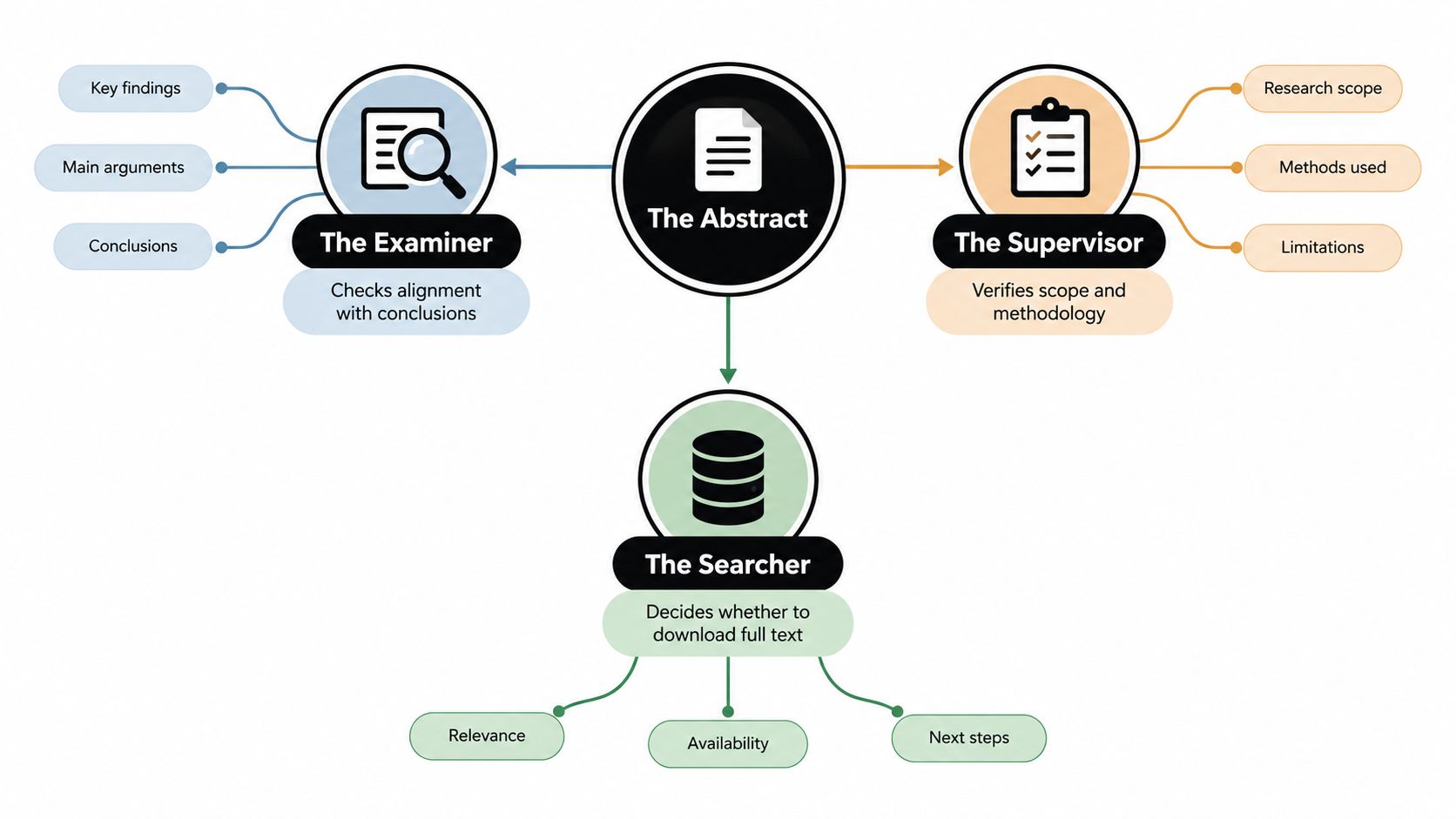
The examiner reads for credibility
An examiner scans for answers to four questions:
- What was the problem? What gap, tension, or puzzle did the dissertation address?
- What did the student do? Did they conduct interviews, analyse archives, build a model, or compare texts?
- What came out of it? Does the abstract report findings rather than only describe intentions?
- Does the conclusion sound earned? Do the claims fit the method and evidence?
Compare these sentences:
This dissertation looks at social media and politics in modern society.
This dissertation analyses how local election candidates used short-form video to frame policy credibility during a recent municipal campaign.
The second sentence gives the examiner a researchable topic, a defined setting, and a clue about the material analysed. It narrows the project enough to judge its scope.
The database reads for retrieval
Oxford's advice on writing abstracts highlights the value of clear problem, method, findings, and conclusion statements, along with keywords and precise method terms that support academic retrieval.
Indexing systems match the words in your abstract with search queries. A researcher looking for particular methods may search for semi-structured interviews or thematic analysis, so those exact terms can affect whether your dissertation appears.
Compare:
- This study used a flexible approach to examine participant views.
- This study used semi-structured interviews and thematic analysis to examine participant views.
The second line identifies the research design and analytical technique. It also gives a database a clearer route to readers searching for either method.
The prospective reader reads for payoff
A future researcher, lecturer, or student often makes a quick decision: is the full dissertation likely to help with their question?
That reader needs a clear account of the contribution. For example:
The study found that participants treated feedback as a measure of approval rather than guidance for revision.
This sentence gives a reader a specific reason to continue. A second sentence can make the subject easier to find:
The study examines feedback literacy, postgraduate supervision, and revision practices in taught master's dissertations.
The first states the finding. The second supplies useful subject terms.
Your abstract therefore works like a labelled map. It establishes credibility for the examiner, uses searchable language for indexing systems, and shows prospective readers what they may gain from reading further. Concise wording serves all three audiences.
The Five Elements Every Abstract Needs
Most university guides converge on a stable five-part order: background or problem, research aim, methodology, principal results, and conclusion or contribution. Oxford's abstract writing advice presents the same sequence, with significance sometimes stated separately.
Building on the audience needs above, this five-part order mirrors how each reader scans for credibility and relevance. An examiner looks for a defensible study, an indexing system looks for precise subject and method terms, and a prospective reader looks for a useful finding. Treat the abstract like a labelled map: each sentence should help the right reader locate something important.
Use one sample study to see how the parts work together: a dissertation on how first-generation postgraduate students interpret written supervisor feedback.
Background or problem
Open with the issue your study addresses. Give enough context for a reader to understand why the research was needed.
First-generation postgraduate students often receive detailed written dissertation feedback, yet little is known about how they interpret and act on that feedback during revision.
The sentence identifies a situation and a gap without becoming a literature review. A database may also use terms such as first-generation postgraduate students, written dissertation feedback, and revision to connect the study with relevant searches.
If the problem still feels vague, a clear research problem statement guide can help you define the issue before shortening it for the abstract.
Research aim
State what the study set out to examine.
This dissertation investigates how first-generation postgraduate students understand written supervisor feedback and how that understanding shapes revision decisions.
Keep the problem and aim separate. The problem describes the situation or gap. The aim names the question your dissertation addresses. For example, “students receive feedback but may interpret it differently” describes the problem, while “the study investigates how they understand it” states the aim.
Methodology
Name what you did, using terms that an examiner and an indexer can recognise.
The study used semi-structured interviews with taught master's students and analysed the data through thematic analysis.
“A qualitative approach was used” gives the reader little to work with. The more specific version identifies the research design and analytical technique. It also helps a prospective reader decide whether the method matches their own research interests.
Principal results
Report the main findings, not every observation.
Participants often read concise feedback as negative judgment, while feedback that included explicit next steps was more likely to prompt focused revision.
This sentence states what emerged from the study. It does not promise that “results are discussed” or refer vaguely to “various themes.” Choose the finding that best answers the research aim. A reader should be able to tell what the study discovered, not only what it investigated.
Conclusion or contribution
End by explaining why the findings matter.
The dissertation argues that effective postgraduate feedback depends not only on content but also on how clearly revision actions are signalled to students unfamiliar with academic feedback conventions.
This gives the abstract a destination. In some fields, you may state the practical significance more directly, but keep the claim proportionate to the evidence. Do not present a recommendation that the study did not support.
The Five Elements of a Dissertation Abstract
| Element | What It Does | Example Sentence |
|---|---|---|
| Background or problem | Shows the issue or gap the study addresses | First-generation postgraduate students often receive detailed written dissertation feedback, yet little is known about how they interpret and act on that feedback during revision. |
| Research aim | States what the dissertation set out to investigate | This dissertation investigates how first-generation postgraduate students understand written supervisor feedback and how that understanding shapes revision decisions. |
| Methodology | Explains how the research was conducted | The study used semi-structured interviews with taught master's students and analysed the data through thematic analysis. |
| Principal results | Reports the key findings | Participants often read concise feedback as negative judgment, while feedback that included explicit next steps was more likely to prompt focused revision. |
| Conclusion or contribution | Explains why the findings matter | The dissertation argues that effective postgraduate feedback depends not only on content but also on how clearly revision actions are signalled to students unfamiliar with academic feedback conventions. |
A fill-in template you can use today
Draft five plain sentences before trying to improve the style:
- This dissertation examines [problem or gap].
- It aims to investigate [specific question or purpose].
- The study uses [method and data].
- The findings show [main result].
- The dissertation concludes that [contribution or implication].
Supervisor advice: Write the plain version first. Clarity matters more than polish in an abstract draft. Once every sentence performs a clear job, remove repetition and replace general terms with the exact keywords a relevant reader might search.
Word Limits and Formatting Rules
Your departmental handbook controls the abstract's length and presentation. General guides offer broad word ranges, but local instructions are authoritative. The George Mason University Writing Center and the UNC Writing Center guide on abstracts provide useful orientation. Use them to understand the genre, then follow your programme's exact requirements.
Check the handbook for the permitted length, heading style, spacing, font, and keyword format. A strong abstract can still fail a submission rule if it exceeds the limit or places keywords incorrectly. Treat the requirements like a frame: your writing must fit inside it without losing its subject.
The reader also affects your wording. An examiner needs a precise account of the research. A database indexer needs recognisable terms, such as “semi-structured interviews” or “thematic analysis,” rather than “information was collected.” A prospective reader needs a clear reason to continue. Choose keywords that accurately name your topic, population, method, and finding.
What must stay out
A dissertation abstract should stand alone, like a short map of the whole study.
- No citations: Write “the study examines supervisor feedback,” not “Smith argues.”
- No figure or table references: Do not write “see Figure 2,” because the abstract must work independently.
- No unexplained abbreviations: Write “higher education” before using “HE,” or avoid the abbreviation.
- No chapter signposting: “Chapter 4 discusses…” describes the document's layout, not its research.
Many abstracts become vague at this point. “A qualitative approach was used” is technically true but thin compared with precise method terms.
Before submission, confirm that a stranger can understand the study, every sentence earns its place, the formatting follows local rules, and the keywords match terms a relevant reader might search. Keywords act as access points to your work in databases and search results.
How to Write a Concise Abstract Step by Step
Most students don't struggle because they have too little to say. They struggle because they try to say everything.
A better method is to draft long, then compress hard.
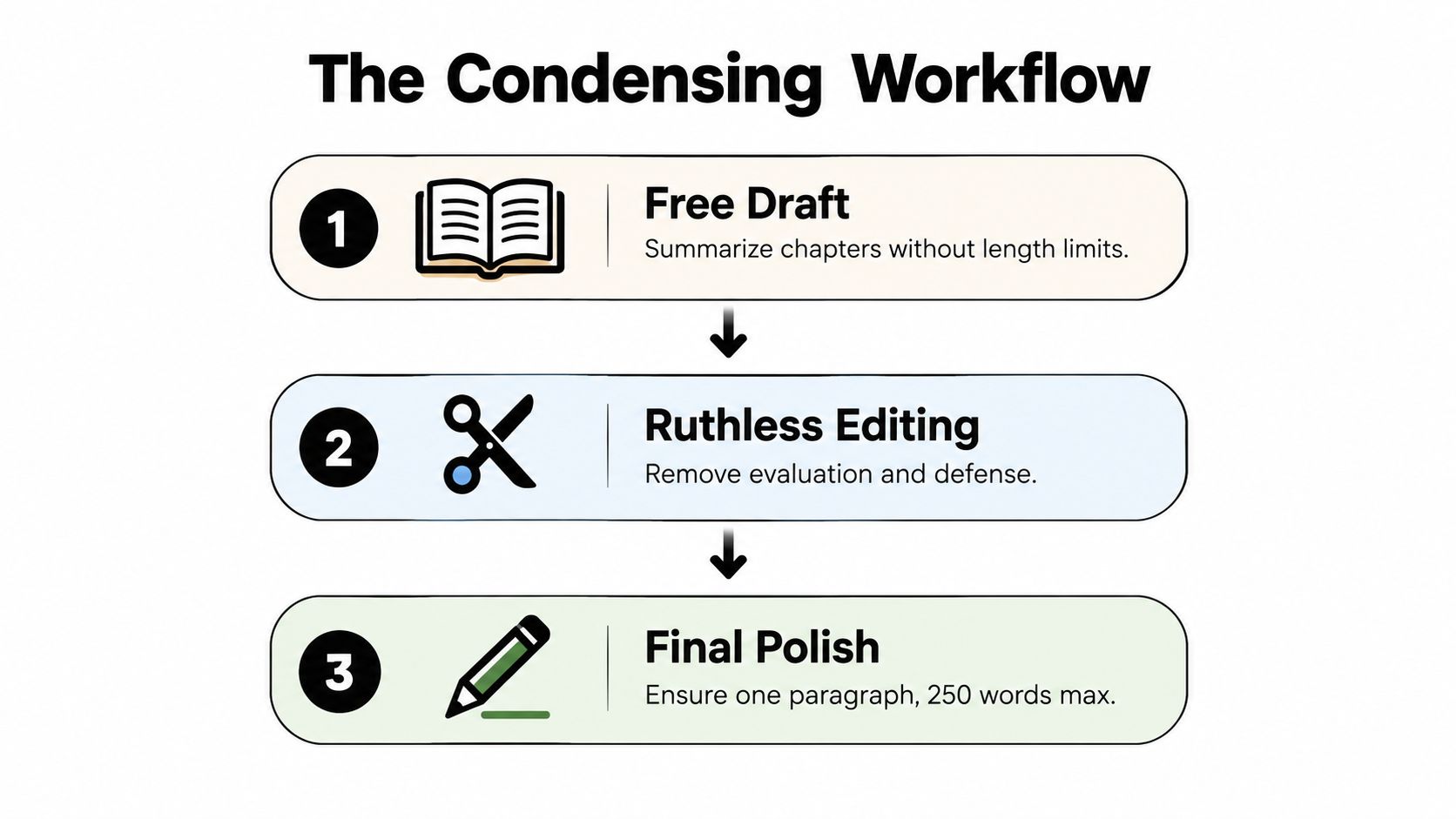
Step one: draft from your chapters
Take one or two lines from each of these parts of your dissertation: the problem, the aim, the method, the main findings, and the conclusion. Put them together without worrying about length yet.
If you use planning tools, this is easier when your chapters already have short summaries. For example, Thesis Book Project includes chapter tracking and milestone planning, which can make it easier to pull the core point from each section rather than rereading the whole document.
Step two: remove defense language
Students often use abstract space to justify the project. That's usually wasted words.
Cut phrases like these:
- This important and timely dissertation
- The study makes a valuable contribution
- It is hoped that these findings will
- This rigorous research clearly demonstrates
Those lines evaluate the work. An abstract should describe it.
Don't tell the examiner your work is important. Give them the problem, the method, and the result. Let those details do the persuading.
Step three: trim background first
When the abstract is too long, students often cut the findings because they're trying to preserve setup. Do the opposite. Keep the results. Trim the scene-setting.
Here's a miniature example.
Before
This dissertation is concerned with the broad and increasingly significant issue of student engagement with written feedback in higher education, a topic that has attracted sustained discussion because of the challenges many students experience when trying to use comments productively. Using qualitative research, the study explored student perceptions and found that many participants were unsure how to convert feedback into revision actions.
After
This dissertation examines how students interpret written feedback in higher education. Using qualitative analysis of student accounts, it found that many participants struggled to translate comments into specific revision actions.
The shorter version is cleaner because it cuts padded phrases like “broad and increasingly significant issue” and “has attracted sustained discussion.”
Three concision habits that work
- Prefer active verbs: “The study examines” is tighter than “The focus of the dissertation is an examination of.”
- Name the method precisely: “Archival analysis,” “semi-structured interviews,” or “comparative textual analysis” usually say more with fewer words than vague alternatives.
- Delete transition-only sentences: If a sentence only connects two ideas and adds no content, cut it.
A short explainer can help if you want to hear these decisions discussed aloud:
Key Takeaways for Your Abstract
Many students think the abstract is just a tiny version of the dissertation. That's not quite right. It's a strategic document that helps one reader judge the work and helps another reader find it in the first place.
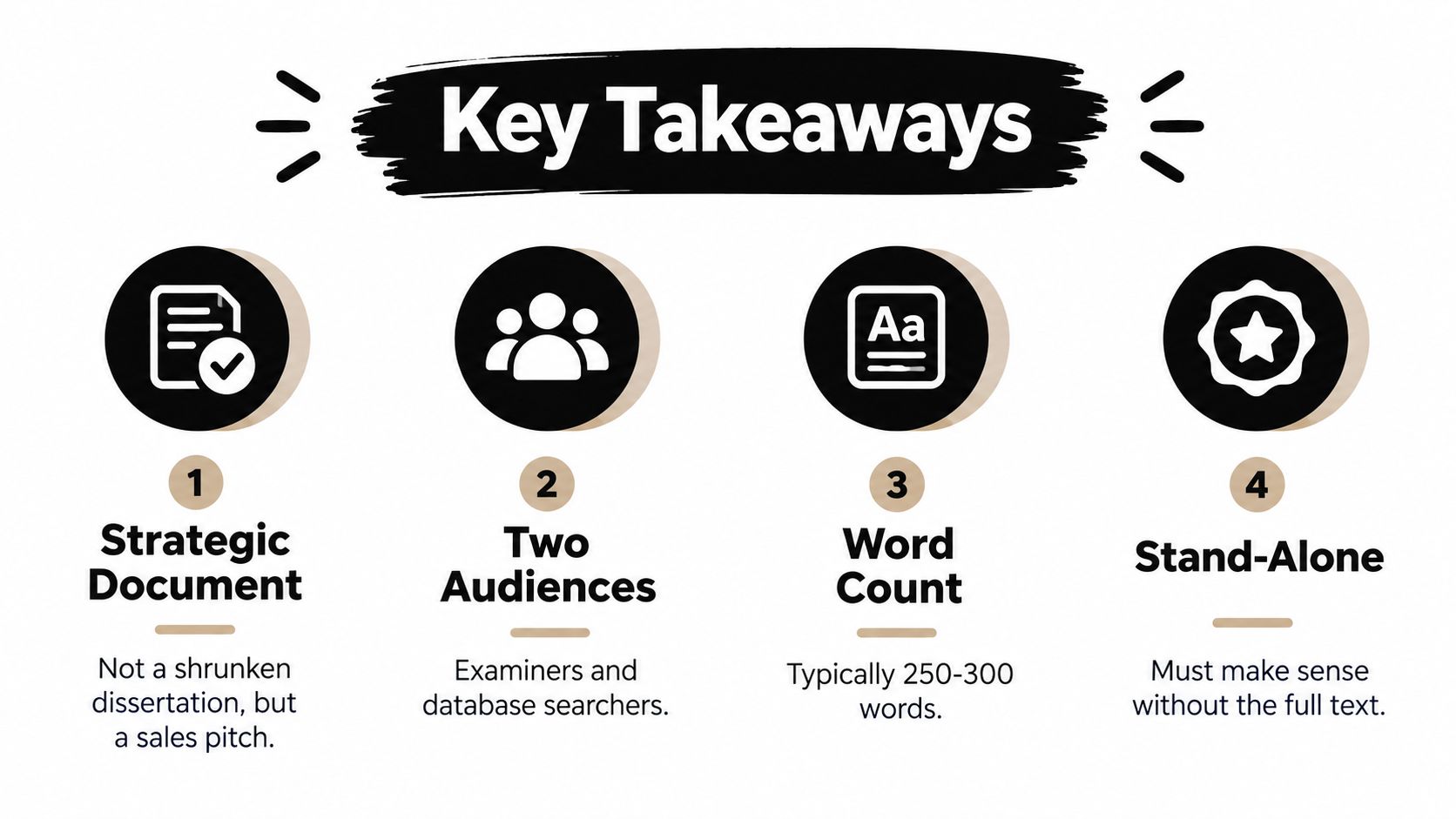
Keep these points in front of you
- Use a tight word range: General guidance places dissertation abstracts in a short range, and many universities expect something around the 150 to 300 word mark based on the sources cited earlier. Your own handbook decides the final limit.
- Follow the five-part order: Problem, aim, method, results, conclusion. That sequence helps readers judge credibility fast.
- Describe, don't defend: Your abstract should report what the dissertation does and finds. It shouldn't argue that the work is impressive.
- Make it stand alone: No citations, no figure references, no hidden context the reader can only get from later chapters.
What examiners usually want to see
Examiners are rarely looking for stylish phrasing in an abstract. They want accuracy, control, and alignment. If the abstract promises one study and the dissertation delivers another, they notice.
A useful final step is to compare your abstract with your conclusion. If they don't point to the same core claim, revise one of them. This guide on writing a dissertation conclusion can help if your final chapter still feels broader or vaguer than the abstract.
Write the abstract in one sitting. Then leave it alone for a day, read it like a stranger, and cut anything that doesn't answer a real question about the study.
Your abstract doesn't need to sound grand. It needs to sound clear, accurate, and readable.
If you're trying to turn a full dissertation into something manageable, Thesis Book Project offers a structured way to plan chapters, track progress, and keep milestones visible while you draft and revise. That's useful when you're writing the abstract because the abstract is much easier to produce when the whole project is already mapped clearly.
Related Articles
Literature Review Table: Templates and Examples
You can have a folder full of PDFs, a half-finished chapter, and still not know what the literature...
Thesis WritingWriting a Strong Thesis Statement: A Practical Guide
A strong thesis statement is the backbone of academic writing. It compresses your entire argument in...
Thesis WritingThe Complete Guide to Writing a Literature Review
The literature review is where many theses are won or lost. Done well, it positions your research wi...
Comments (0)
No comments yet. Be the first to share your thoughts.