Systematic Review Dissertation Structure: A Chapter Guide
Systematic Review Dissertation Structure, chapter by chapter: the purpose of each section, PRISMA mapping and the appendices examiners expect.

You've exported hundreds of citations from four databases, saved a spreadsheet of screening decisions, and opened your university's blank thesis template. The template gives you five generic headings, yet it doesn't tell you where your search strings belong, whether excluded papers go in the results chapter, or how much risk-of-bias detail examiners expect in the main body.
Most students hit this exact wall halfway through drafting. A systematic review dissertation structure doesn't work like a standard empirical thesis or a conventional literature review. It functions as an audit trail, built so an examiner can trace every conclusion back to a predefined search, a screening decision, and a quality judgement.
Knowing the chapter titles is only half the job. The main challenge is sorting which pieces of evidence belong in the main narrative and which belong in the appendices, so your thesis reads cleanly while remaining completely reproducible.
Table of Contents
- Chapter Map at a Glance
- Why Transparency Shapes Every Chapter
- Writing an Introduction Around a Focused Review Question
- How to Write the Methods Chapter Step by Step
- Results, Synthesis and Discussion Without Overclaiming
- Writing the Discussion and Conclusions Chapter
- Appendices and the Audit Trail Examiners Check
- Confirm Your Chapter Plan Before You Write
Chapter Map at a Glance
Before you write a single paragraph, you need to see how the whole thesis fits together. Every chapter carries one distinct job, and examiners read them in a fixed sequence to test whether your findings follow from your protocol.
| Chapter | Purpose | Typical contents | PRISMA section |
|---|---|---|---|
| Title and abstract | Let examiners judge scope quickly | Structured abstract, review question, key record counts | Title and abstract |
| Introduction | Define the problem and the review question | Rationale, objectives, PICO-style question, prior reviews | Introduction |
| Methods | Record what was done so it can be repeated | Eligibility criteria, sources and dates, search strings, screening, extraction, risk of bias, synthesis plan | Methods |
| Results | Report what the search and appraisal found | Flow-diagram counts, study characteristics, risk-of-bias findings, synthesis output | Results |
| Discussion and conclusions | Interpret findings and answer the review question | Main findings, heterogeneity, limitations, certainty of evidence, direct answer, implications, future research | Discussion |
| Appendices | Provide the audit trail | Full search strings, excluded-study reasons, templates, appraisal tables | Other information |
This sequence reflects a reproducible evidence pipeline rather than a loose thematic essay. As the PRISMA 2020 explanation and elaboration document outlines, mapping dissertation chapters to specific methodological decisions reduces discretionary selection and lets another researcher reconstruct how you moved from a broad question to included studies.
Where Chapters Commonly Drift
Students rarely get the overall order wrong, yet material frequently lands in the wrong chapter. Three misplacements cause the most examiner comments during review.
- Study-selection counts placed in Methods: Your methods chapter states how you planned to search and screen, not how many papers came back. Record counts, duplicate removals, and full-text exclusions are outputs of your search, so they belong at the start of the results chapter.
- Synthesis choices delayed until Results: PRISMA reporting requires you to specify how you'll present and synthesize findings before you inspect the data. Waiting until the results chapter to explain why you ran a narrative synthesis instead of a meta-analysis looks like post-hoc decision-making.
- Full database strings pasted into the main text: Dropping multi-page Boolean strings for MEDLINE, Embase, and PsycINFO into the middle of your methods chapter breaks readability. Summarize the databases, core concepts, and search dates in the chapter, then house the verbatim strings in an appendix.
Two Quick Draft Checks
Apply two tests to any outline or early draft before sending it to your supervisor. First, check that every chapter performs one clear job without spilling into its neighbor's territory.
Second, verify that your methods chapter reads as a record locked in from your protocol before results were known. If an examiner can spot where your eligibility rules shifted after you saw the retrieved studies, the whole dissertation loses credibility.
Why Transparency Shapes Every Chapter
Think of the difference between a narrative literature review and a systematic review the way you'd compare two cooks. A narrative reviewer describes a memorable meal from memory, highlighting the flavors that stood out and skipping the steps that felt routine. A systematic reviewer writes a precise recipe so a stranger in another kitchen can measure the same ingredients, follow the same sequence, and produce the same dish.

Examiners assess your dissertation against that second standard. They aren't just checking whether you read widely; they're checking whether your review can be independently reproduced and evaluated by someone who wasn't in the room while you screened papers.
How PRISMA 2020 Maps Onto Your Thesis
The shared yardstick across health sciences, psychology, education, and social policy is the PRISMA 2020 reporting standard. Published as an update to earlier guidance in 2021, the PRISMA 2020 statement sets out a 27-item checklist organized into 7 sections: title, abstract, introduction, methods, results, discussion, and other information covering registration, funding, conflicts of interest, and data availability.
It also provides a structured abstract checklist and revised flow-diagram templates. Together, those components turn study selection from an invisible administrative chore into a documented, auditable stage of the research.
In dissertation form, those seven sections translate directly into your thesis architecture:
- Front matter and structured abstract: Captures the review question, eligibility scope, key record counts, and headline conclusions at a glance.
- Core chapters (Introduction through Discussion): Walks the reader through the rationale, predefined methods, retrieved evidence, and bounded interpretation.
- Appendices and governance notes: Captures protocol registration details, funding statements, conflicts of interest, and full reproducibility documentation.
Tracing an Evidence Pipeline in Practice
Every stage of the pipeline is decided in advance to keep personal bias out of study selection. Eligibility criteria, database selection, search dates, screening rules, extraction fields, and synthesis plans lock down the process before you know which papers support which argument.
Consider a hypothetical review examining workplace sleep interventions. In the results chapter, the student reports that 1,240 records were identified across four databases, 310 duplicates were removed, 930 titles and abstracts were screened, 85 full texts were assessed, and 14 studies met all inclusion criteria, with a specific reason recorded for every one of the 71 full-text exclusions.
The stranger test: Hand your draft to a researcher outside your department. Could they reconstruct exactly what you searched, when you searched it, and why every excluded full text was cut from your text and appendices alone?
If the answer is no, the problem isn't prose polish. A link in the audit trail is missing, and an examiner will find it.
Writing an Introduction Around a Focused Review Question
An introduction in a systematic review dissertation has three tightly bounded jobs. It establishes why the problem matters, proves why a new systematic review is needed right now, and states a review question narrow enough to answer cleanly within your timeframe.
Unlike an open-ended essay, your introduction isn't a place to wander through decades of tangential theory. If you're unsure how to keep early background crisp while steering straight toward the research gap, Access Courses Online dissertation advice offers helpful context on pacing an opening chapter without losing focus.
Turning a Broad Topic Into a PICO Question
Broad topics break systematic reviews. A vague goal like exploring exercise and mental health yields tens of thousands of hits and makes consistent screening impossible. You need a structured framework to constrain the scope before you touch a database.
Watch how a clinical topic narrows step by step using the PICO framework (Population, Intervention, Comparator, Outcome):
- Start with the broad issue: Physical activity and depression in older people.
- Define the Population (P): Adults aged 65 and over experiencing depressive symptoms, excluding hospitalized psychiatric patients.
- Define the Intervention (I): Structured exercise programmes lasting at least eight weeks, delivered individually or in groups.
- Define the Comparator (C): Usual care, waitlist control, or an attention-matched non-exercise control.
- Define the Outcome (O): Validated depression symptom scores measured at 12 weeks post-baseline.
Put those pieces together and you get a single, searchable review question: Do structured exercise programmes reduce validated depression scores at 12 weeks compared with usual care or attention control in adults aged 65 and over with depressive symptoms?
Not every dissertation tests an intervention. If your review asks a qualitative or mixed-methods question in education, sociology, or management, swap PICO for SPIDER (Sample, Phenomenon of Interest, Design, Evaluation, Research type). State your chosen framing explicitly before running your first search, and review our guide on how to write a research question if your scope still feels too wide to operationalize.
Reviewing Prior Reviews and Locking the Protocol
Before claiming your review fills a gap, examine the systematic reviews already published on your topic. Show examiners what those earlier reviews covered, when their searches ended, what populations or outcomes they left out, and why an updated or differently scoped synthesis is justified.
Next, make your review objectives mirror your review question word for word. If the question asks about depression scores at 12 weeks, your primary objective shouldn't suddenly introduce quality of life or six-month adherence without naming them as explicit secondary objectives.
State your review question in one clear sentence, then verify that every single objective points directly to a concrete result your results chapter will report.
Finally, document or register your review protocol before starting the search, using a public register such as PROSPERO (for health-related outcomes) or OSF (for social sciences and other disciplines). State in your introduction where the protocol is archived and explain that any later deviations will be logged transparently in your methods chapter. Never bury the review question in background paragraphs, and never rewrite it after screening to fit the papers you happened to find.
How to Write the Methods Chapter Step by Step
Your methods chapter is the engine room of the dissertation. Examiners read it with a sceptical eye because your conclusions are only as trustworthy as the procedures that produced them.
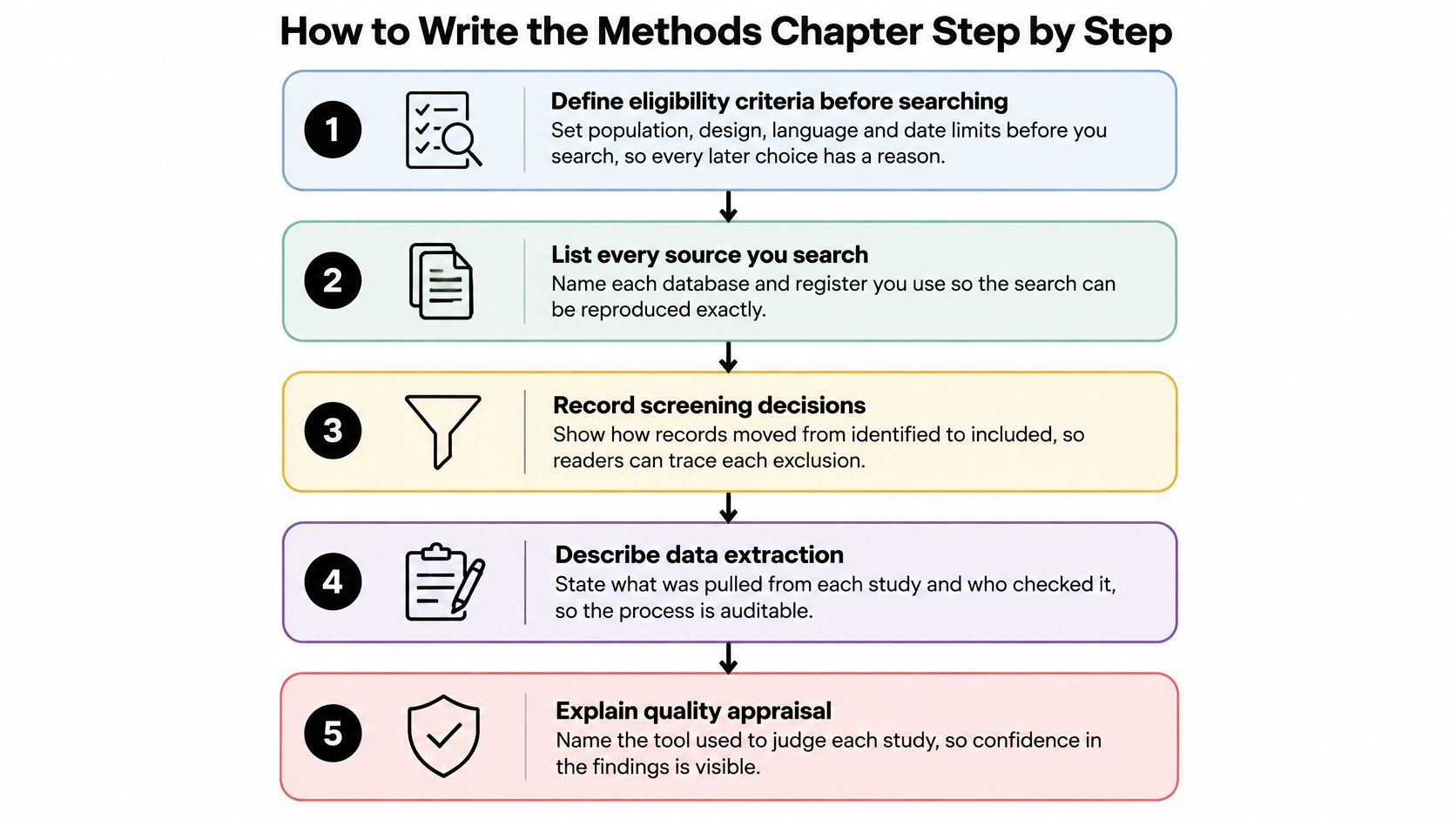
The visual flowchart below captures the core sequence that turns a review protocol into a reproducible methods chapter.
A helpful benchmark for organizing this work comes from the Cochrane Handbook for Systematic Reviews of Interventions, which structures its core methodology across 15 chapters covering effect measures, bias and conflicts of interest, risk of bias in randomized trials, meta-analysis, synthesis using other methods, missing results, Summary of Findings tables, and GRADE interpretation. Cochrane guidance stresses that a methods section must report what you did to obtain the results of your review, rather than reciting general textbook explanations of what systematic reviews are.
Seven Steps to Document Completed Procedures
Write your methods chapter in the past tense as a precise record of completed actions. If you're still getting comfortable with methodological prose, our walkthrough of the methodology chapter explained for beginners breaks down how to justify each choice cleanly.
- Define eligibility criteria before searching. List exact inclusion and exclusion rules for population, intervention or phenomenon, comparator, outcomes, study designs, publication languages, and date limits. State why any restriction exists, such as limiting dates to after a major diagnostic manual revision, so examiners see scientific logic rather than convenience.
- Name every information source and exact search date. List each electronic database (such as MEDLINE via PubMed, Embase, CINAHL, PsycINFO, or Web of Science), trial register, and grey-literature source you searched. Record the exact day, month, and year each search ran, because an identical query run three months later returns a different record count.
- Construct database-specific search strategies. Explain how you combined controlled vocabulary (like MeSH or Emtree headings) with free-text keywords and Boolean operators. Note whether a subject librarian reviewed your strings, describe your approach in the chapter, and point readers to the full line-by-line syntax in your appendix.
- Detail your two-stage screening workflow. Explain how you exported records, removed duplicates (using tools like Zotero, EndNote, Covidence, or Rayyan), screened titles and abstracts, and then assessed full texts. Name who screened independently at each stage and specify how disagreements were resolved, whether by consensus discussion or a third reviewer.
- Specify data-extraction fields in advance. Name the exact variables you extracted from each included paper, such as author, year, setting, sample size, baseline demographics, intervention duration, comparator details, and outcome statistics. Mention whether you piloted the extraction form on a few studies first and whether a second reviewer verified the extracted figures.
- Identify your risk-of-bias tool and scoring process. Match the appraisal instrument to your study designs: RoB 2 for randomized trials, ROBINS-I for non-randomized intervention studies, or the Newcastle-Ottawa Scale for observational cohorts. Explain how domain-level judgements were recorded and how discrepancies between assessors were settled.
- Commit to a prespecified synthesis plan. State whether you planned a meta-analysis, a structured narrative synthesis, or both, and write down the exact criteria deciding between them. Specify the effect measure, statistical model, and planned subgroup or sensitivity checks before inspecting the study outcomes.
If you'd like to see how these planning and reporting stages connect in practice, the video below walks through assembling a clear systematic review workflow.
Three Mistakes That Undermine Methods Chapters
Examiners flag the same three errors repeatedly in student drafts:
- Writing in the future tense: Leaving proposal-stage phrasing like "two reviewers will screen titles" signals that you copied your proposal without updating it to reflect what happened.
- Padding with textbook definitions: Spend your word count documenting your own decisions, not explaining the history of meta-analysis or defining Boolean logic for your examiners.
- Hiding post-hoc criteria shifts: If an unexpected study design or outcome measure forced you to adjust an eligibility rule mid-review, don't rewrite the methods as if you always planned it. State the original rule, document the change, and explain why it was necessary.
Results, Synthesis and Discussion Without Overclaiming
Many dissertation writers assume that a pooled statistical estimate is automatically superior to a narrative synthesis. It isn't. Combining apples, oranges, and tennis balls into a single average produces a tidy-looking number that misleads anyone trying to apply your findings.
Your results chapter should unfold in two disciplined halves. First, report what you found and how reliable it is: present the PRISMA flow diagram, tabulate the characteristics of every included study, and display your risk-of-bias judgements. Only after laying out study differences and study quality should you justify and execute your synthesis.
Choosing a Synthesis Approach That Fits the Evidence
Your included studies dictate whether statistical pooling is defensible. Use the decision matrix below to match your synthesis method and reporting details to the evidence you retrieved.
| Study situation | Synthesis approach | What to report |
|---|---|---|
| Studies comparable in population, intervention, comparator and outcome | Meta-analysis | Effect measure, model, uncertainty interval, heterogeneity statistic |
| Comparable outcomes with meaningful clinical or methodological diversity | Meta-analysis with sensitivity or subgroup analyses | Justification for pooling, prespecified subgroups, results of each analysis |
| Outcomes or designs too varied to pool | Structured narrative synthesis | Prespecified outcomes or explanatory categories, with study-level evidence |
| Few studies, mostly with high risk of bias | Narrative synthesis with cautious claims | Appraisal findings and explicit limits on certainty |
When studies differ in participant ages, intervention intensity, comparator type, follow-up duration, or research design, those clinical and methodological differences show up as statistical heterogeneity. As Chapter 10 of the Cochrane Handbook explains, statistical heterogeneity reflects variability in intervention effects across studies, and relying on a fixed-effect confidence interval can ignore between-study variation entirely.
Even when you choose a random-effects model, the pooled result represents an average effect across diverse settings, not a single universal truth. You still have to investigate and interpret where that variability comes from through prespecified subgroup or sensitivity analyses.
Executing a Structured Narrative Synthesis
When pooling isn't scientifically defensible, don't default to vote counting by tallying how many studies showed positive versus negative effects. Vote counting ignores sample size, effect magnitude, and study quality.
Instead, organize a structured narrative synthesis around your prespecified outcomes or explanatory categories (following structured reporting frameworks such as SWiM). Present study-level effect directions, ranges, and design features clearly so readers see patterns without pretending the studies are statistically identical.
Connecting Appraisal to Interpretation
Critical appraisal belongs inside your interpretation, not quarantined in an isolated results table. Alongside Cochrane tools, structured appraisal instruments like the JBI systematic-review checklist use 11 questions covering methodology, search strategy, and bias reduction to guide how strongly you can trust the evidence.
Weak appraisal or unexplained heterogeneity produces precise-looking conclusions that don't generalize.
Every claim you carry forward into your discussion must reflect both the quality of the underlying studies and the consistency of their findings.
Writing the Discussion and Conclusions Chapter
Your discussion chapter has one central task: answer the review question strictly within the boundaries your evidence supports. Strong discussions don't repeat every number from the results chapter, and they never smuggle in fresh data that wasn't reported earlier.
Start by restating your review question and summarizing the main finding for each outcome in the exact order your results chapter presented them. That mirror structure helps examiners check your reasoning without flipping back and forth across fifty pages.
Anchoring Every Claim to Certainty and Context
Once the headline findings are on the table, weave four analytical layers into your prose before closing the chapter:
- Certainty of evidence: Interpret each finding through your appraisal judgements for risk of bias, inconsistency across studies, and imprecision in the estimates. Let certainty language (such as "probably reduces" or "the evidence is very uncertain") replace overstated verbs like "proves."
- Sources of heterogeneity: Explain which concrete differences among included studies, such as intervention duration, delivery setting, or baseline severity, likely drove the spread in outcomes.
- Two separate sets of limitations: Distinguish limitations of your review process (such as English-only screening, a search cut-off date, or a small retrieved study pool) from limitations inside the primary studies themselves (such as high dropout rates or unblinded outcome assessors).
- Comparison with prior reviews: Return to the earlier systematic reviews you cited in your introduction. Spell out where your findings agree, where they diverge, and whether newer trials, stricter eligibility rules, or a different appraisal tool explain the shift.
For practical phrasing models and structural checks when balancing these elements, read our detailed guide on how to write a discussion chapter in a thesis.
Closing With Bounded Conclusions
Keep your conclusions section crisp and direct. Give examiners a plain answer to the review question covering three exact points: what the evidence currently supports, what it cannot tell us yet, and which specific future study designs would change certainty.
Returning to our earlier exercise example, a disciplined conclusion reads like this: Structured exercise programmes probably reduce depression scores in adults aged 65 and over at 12 weeks compared with usual care, but the evidence is too uncertain to determine whether those gains persist beyond 12 months. Follow that sentence with concrete implications for practice or policy and a specific recommendation for longer-term randomized trials with blinded follow-up.
Appendices and the Audit Trail Examiners Check
Most university thesis templates hand students a standard AIMRaD-style outline (abstract, introduction, methods, results, and discussion) and add a brief footnote saying to attach search strings and appraisal tables at the end. As Federation University's systematic review thesis guidance illustrates, knowing the chapter headings is only the starting point.
The harder architectural question is how to split your evidence between the main narrative and the supplementary material. A dissertation can follow the "correct" chapter order down to the last subheading and still fail methodological scrutiny if an examiner can't trace and verify your underlying decisions.
The Distribution Principle
One rule solves almost every placement dilemma: the main text must let a reader follow every decision, and the appendices must let an examiner verify each one.
Think of your appendices as a minimum reproducibility package. It holds the exact search strings and database dates, the itemised list of full-text exclusions with reasons, domain-level risk-of-bias judgements for every study, your extraction templates, and a dated log of every deviation from your protocol.
| Evidence item | Main text | Appendix |
|---|---|---|
| Record counts (identified, screened, excluded, included) | Summarised in results with the PRISMA flow diagram | Full log of records by database |
| Database search strings and dates | Summarised in methods | Full strings and search dates for each database |
| Reasons for full-text exclusions | Count of exclusions by reason in results | Itemised list of excluded studies with reasons |
| Risk-of-bias judgements | Summary by domain in results | Study-level appraisal tables |
| Data-extraction fields | Named fields in methods | Blank and completed extraction templates |
| Deviations from the protocol | Stated in methods with the reason | Supporting detail and dated decision record |
| Supplementary or sensitivity analyses | Brief description and key finding | Full analysis outputs |
How That Split Works in Practice
Look at full-text exclusions to see why this separation matters. In your results chapter, readers shouldn't wade through a four-page list of rejected papers; they need a clean summary showing, for instance, that 28 studies were excluded for wrong comparator, 19 for wrong outcome measure, and 12 for non-eligible age groups.
An examiner checking for selection bias, however, will flip straight to the appendix to inspect the itemised table naming each excluded study alongside its exact exclusion reason. Both audiences get exactly what they need without cluttering the narrative.
Keeping Your Audit Trail Clean From Day One
Rebuilding an audit trail three weeks before submission is miserable and error-prone. Keep every database export, deduplication count, screening decision, and PDF inside one organized reference library from your very first search so your appendices compile cleanly from a single source.
Inside Thesis Book Project, our Source manager keeps references and reading organised in one place, so your extracted citations and screening notes stay connected to the chapters that cite them.
Confirm Your Chapter Plan Before You Write
Drafting a systematic review before locking your chapter plan and protocol invites painful rewrites later. Examiners and peer reviewers expect standardized reporting from the start: a 2025 cross-sectional study indexed on PubMed found that 99% of systematic-review peer reviewers were familiar or very familiar with PRISMA, while 53% reported always using it during peer review.
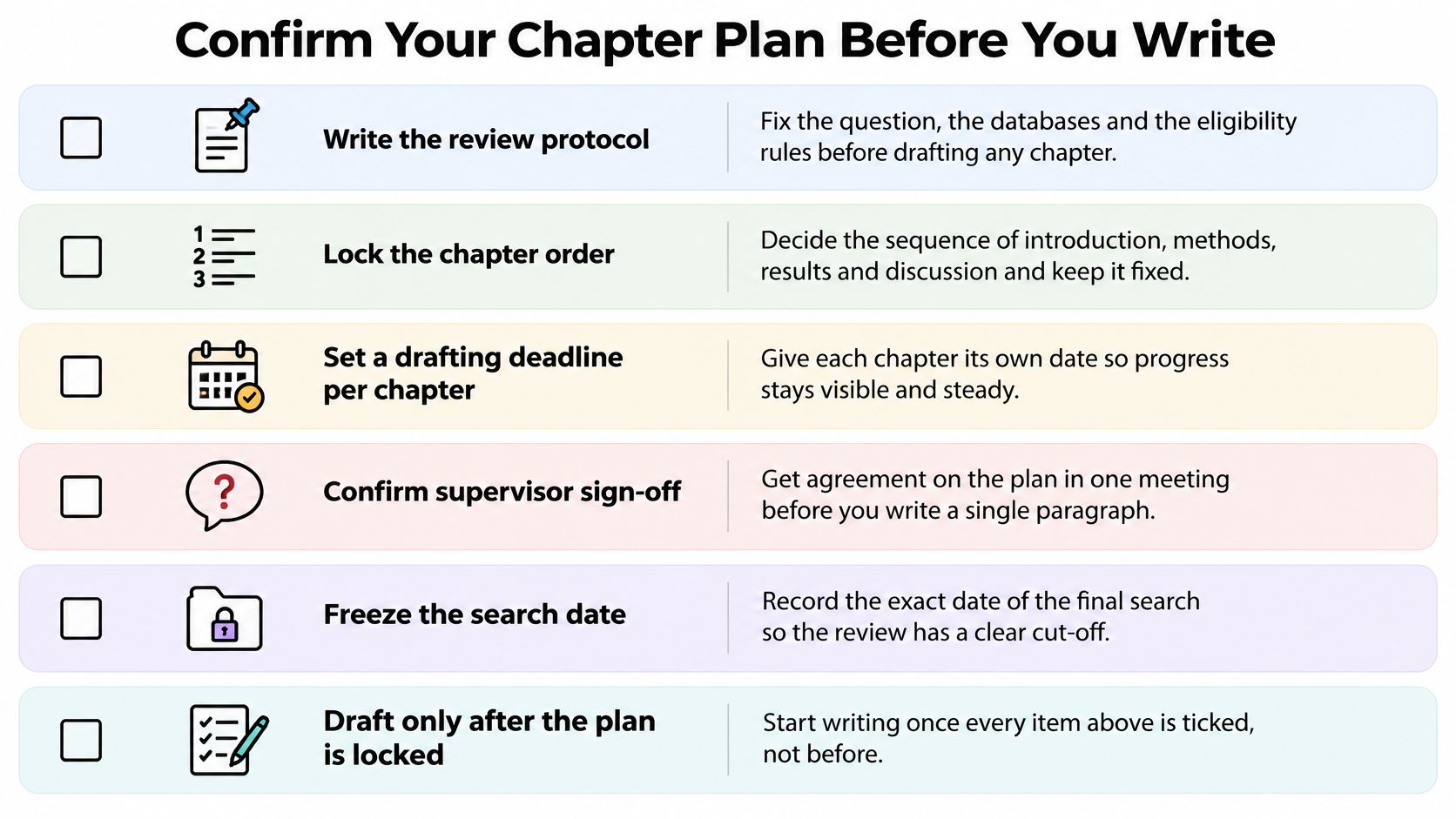
Run through this six-point lock-in check in one sitting before writing your first chapter draft:
- Test your question and objectives. Write the review question in one sentence and confirm that every objective maps to a concrete output in your results chapter.
- Freeze eligibility rules and search dates. Finalize your inclusion criteria, pick your databases, and record your protocol date before screening begins.
- Cross-check your PRISMA 2020 map. Confirm every reporting item has a designated home in either the main text or the appendices.
- Lock the synthesis decision rule. Commit to your planned synthesis approach and specify the exact clinical or statistical criteria that would alter it.
- Schedule backwards from submission. Set chapter drafting deadlines working backwards from your final hand-in date, building in buffer weeks for supervisor feedback.
- Get supervisor sign-off on the plan. Agree the chapter sequence, protocol scope, and appendix package in one meeting so your first draft addresses the methodological blockers your committee will later examine.
A plan stored only in your head is nearly impossible to audit or defend. Keep your checklist, protocol date, and chapter milestones in one dated workspace that your supervisor can review at a glance. At Thesis Book Project, the Thesis roadmap turns the whole thesis project into a step-by-step roadmap from proposal to submission, the Chapter tracker breaks a thesis into chapters and sections and tracks each one from outline to final draft, and Supervisor check-ins let users share their progress with their supervisor without endless email threads.
Structuring a systematic review dissertation is far easier when your protocol, chapters, and sources live in one organized workspace instead of scattered folders. With a guided roadmap, chapter-by-chapter tracking, backward milestone scheduling, and supervisor progress sharing built specifically for academic writing, you can keep every piece of your review audit trail on track from first search to final submission. Explore the tools and human-written academic guides waiting for you at Thesis Book Project.
Related Articles
How to Track Progress on Your Thesis: A Milestone Guide
It's month seven. You've got forty PDFs open, a folder of half-coded transcripts, and a chap...
Thesis WritingSource Management for Thesis Writers Made Simple
Source management is the habit of recording where every idea, quotation, and dataset came from the m...
Thesis WritingDissertation Timeline Template: How to Plan Backward
You've put a spring submission date on your calendar, and it still looks manageable. Then you co...
Comments (0)
No comments yet. Be the first to share your thoughts.