Proofreading vs Copyediting: Which Your Thesis Needs
Proofreading vs copyediting explained for thesis writers: what each checks, when each fits your draft, and how to book the right pass before submission.
Your thesis is due in a few weeks, the argument finally holds together, and you're staring at two quotes that look almost identical. One service promises to clean up grammar and citations, the other promises a final polish, and the price difference makes the cheaper one tempting. That choice isn't really about price or grammar. It's about how locked your text is, and how much risk you're carrying if a wording change alters what you're claiming without you noticing. Get the order wrong and you'll either pay to polish sentences you'll still rewrite, or submit pages that look tidy while the prose underneath stays uneven.
Table of Contents
- Proofreading vs Copyediting at a Glance
- Choosing Between Them by Draft Risk
- How Copyediting Works on an Unfinished Thesis
- Step-by-Step Proofreading of the Final Pages
- Which Errors Each Service Catches and Misses
- Using AI Tools Without Losing Accountability
- Booking the Right Pass Before Submission
Proofreading vs Copyediting at a Glance
In the question of proofreading vs copyediting, the core difference is simple. Copyediting works on the manuscript while its content can still change, improving clarity, consistency and style. Proofreading checks the final rendered pages after design and typesetting, looking for what layout introduced or left behind.
The University of California San Diego guide to copyediting and proofreading identifies proofreading as the final manuscript stage before printing and states that the two terms aren't interchangeable. Copyediting covers sentence clarity, grammar, punctuation, spelling, capitalization, hyphenation, terminology, numbers, quotations, citations, footnotes and adherence to a style guide, and it may include factual checks such as verifying a date. Proofreading covers residual typos, dropped words or paragraphs, wrong page numbers, broken headings, awkward line breaks, missing captions, inconsistent margins and mismatches between chapter titles and the table of contents.
Copyediting and Proofreading Side by Side
| Criterion | Copyediting | Proofreading |
|---|---|---|
| When it happens | Before layout, while content can still change | After design and typesetting, on the final pages |
| Object of work | Manuscript text and its consistency | Final PDF or printed proof |
| Typical tasks | Clarity, grammar, terminology, citations, style guide | Typos, dropped lines, page numbers, cross-references, captions |
| Can wording change meaning? | Yes, so the author must approve changes | No, changes are limited to errors |
| Typical output | Tracked revisions and author queries | Marked errors on the final proof |
Why the Order Matters
Copyediting after layout creates expensive reflow. Rewrite a paragraph in a typeset PDF and page breaks shift, the contents page goes stale, and figure placement moves. Proofreading before content is locked wastes effort in the opposite direction, because you're checking page numbers for text that's about to change length.
For a thesis, that means copyediting should settle language, citations and academic style before formatting is locked. Proofreading should then inspect the final PDF for errors the layout itself introduced.
Practical rule: Edit the words first, proof the pages last.
If you're holding an editable Word or LaTeX draft, you need the first job. If you're holding the submission PDF, you need the second.
Choosing Between Them by Draft Risk
Say your draft reads, "The results suggest a clear effect," and an editor changes it to, "The results show a clear effect." The grammar is fine either way. The claim isn't. Suggest is cautious, show is certain, and in a thesis that gap can be the difference between a defensible conclusion and an overclaim your examiner presses you on.
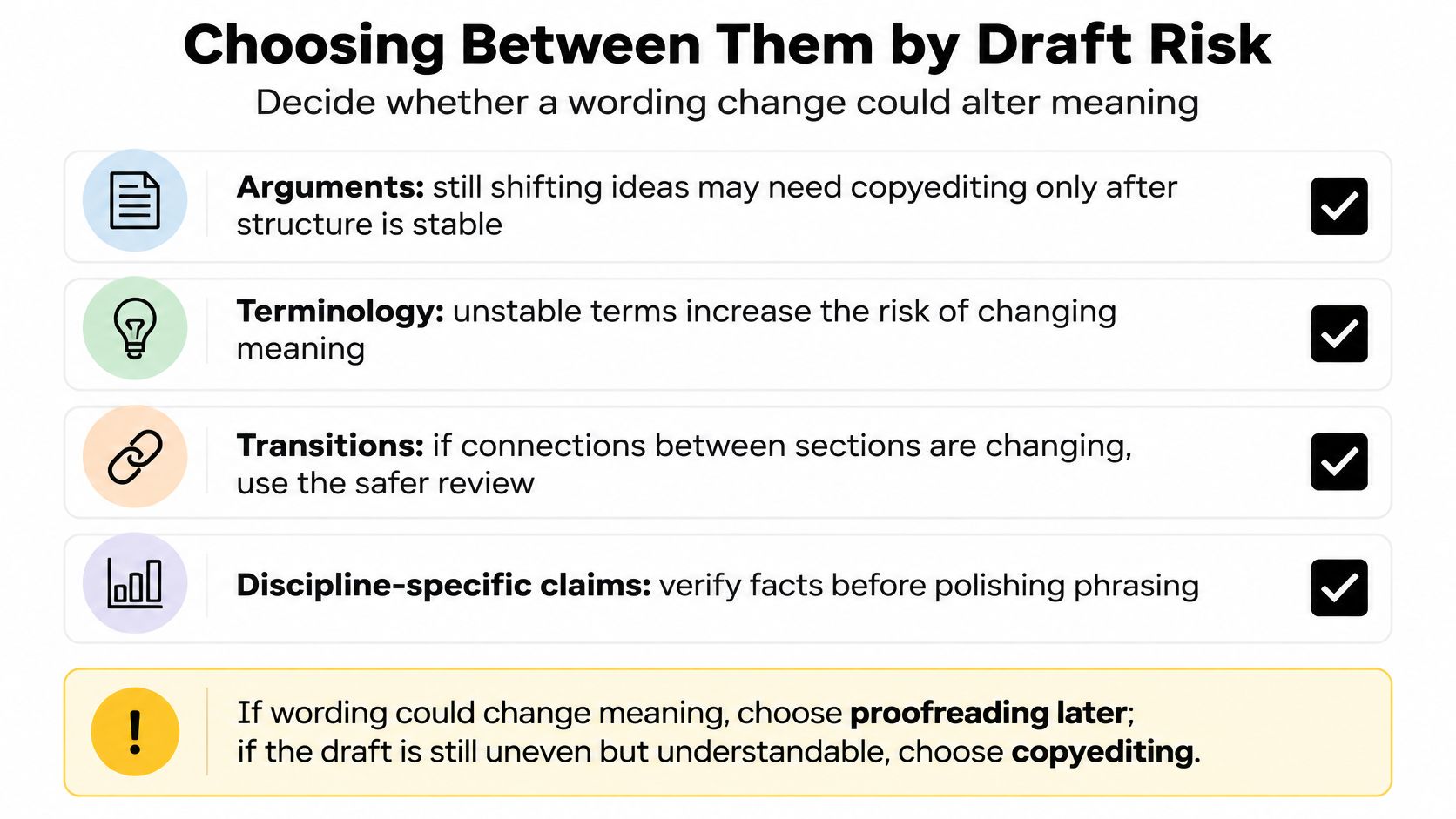
That's the clear boundary in proofreading vs copyediting. It's not grammar versus no grammar. It's whether changing the wording could change the meaning, and who gets to decide.
The Decision Rule Under Uncertainty
If your arguments, terminology, transitions or discipline-specific claims are still developing, copyediting is the safer service. A copyeditor works sentence by sentence, improves flow, applies your style guide, and queries anything that looks inaccurate rather than changing it without telling you. If your content is locked and the remaining risk is typographical, formatting or cross-reference error, proofreading fits, because the job is checking final pages, references, numbering and placement.
The IPEd academic editing FAQs handout separates those two sets of tasks in exactly this way, with copyediting handling flow, style and queries about inaccuracies, and proofreading handling final pages, numbering and placement. That separation protects you. It stops a late-stage checker from making judgment calls about your evidence, and it stops an early-stage editor from being blamed for pagination that didn't exist yet.
Four Questions to Answer Today
- Is the argument settled? If a supervisor might still ask you to restructure a chapter, don't pay for a final-page check yet.
- Is the terminology fixed? If you're still swapping between two names for the same concept, you need consistency work, not a typo hunt.
- Are the citations complete? Missing or mismatched references belong in copyediting, while there's time to chase sources.
- Has the layout been locked? If margins, headings and page breaks are final, proofreading can do its job properly.
Three or four "no" answers point to copyediting. Four "yes" answers point to proofreading.
Boundaries Neither Service Crosses
Neither service should rewrite your argument, verify your entire evidence base, or repair a weak research design. If a provider offers to do those things without queries back to you, that's a warning sign, not a bonus.
This matters most if you're a multilingual researcher. Making English more idiomatic can unintentionally shift disciplinary nuance, because the natural-sounding word isn't always the precise term of art. I'd insist on tracked changes and approval for every substantive edit, so fluency never trades away accuracy.
How Copyediting Works on an Unfinished Thesis
Copyediting is the right pass when your argument and chapter structure are stable, but sentences, terms and citations can still move. Uneven but understandable isn't a reason to skip ahead. It's the exact condition this stage exists for.
The setup below shows the working state this stage assumes, with an editable manuscript rather than a finished PDF.
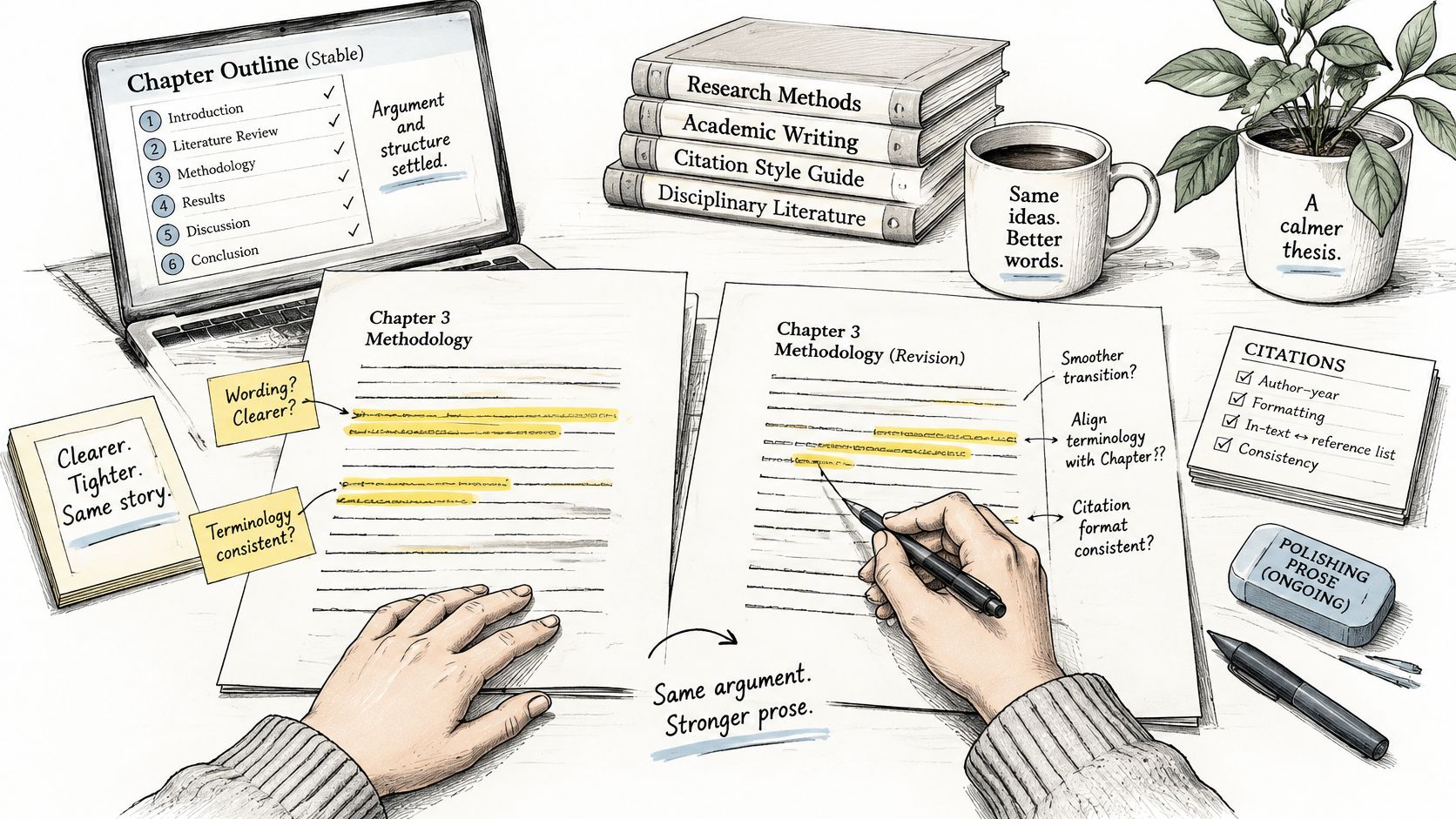
The Australian Government Style Manual guidance on editing and proofreading describes copyediting as a test of whether text is accurate, complete, consistent, readable and compliant with the applicable style guide, performed after substantive content is settled but before final production. On a thesis, that breaks into five passes.
The Five Passes on Your Chapters
First, standardise terminology. One concept should carry one name in every chapter. If Chapter 2 says "participants," Chapter 4 says "respondents" and Chapter 5 says "subjects" for the same group, readers wonder whether the groups differ.
Second, resolve sentence-level grammar, syntax and punctuation. The editor untangles sentences without upgrading a cautious claim into a certain one. Shortening a clause is fine. Strengthening a verb is a query, not an edit.
Third, check citations and the reference list against your department's style guide. That includes matching every in-text citation to a list entry and applying one consistent format for dates, italics and capitalisation.
Fourth, flag ambiguous claims, weak transitions and factual anomalies. A wrong date, a cross-reference pointing at the wrong section, or a paragraph that contradicts an earlier finding all get raised while revision is still feasible.
Fifth, return those points as author queries rather than silent rewrites. You stay in control of meaning, and there's a record of every decision.
This short walkthrough shows how tracked queries look in practice before you accept or reject them.
What a Good Query Looks Like
Your sentence reads, "The results show a clear effect." Instead of changing it, the editor comments, "Your data in Table 4.2 look tentative. Do you mean suggest here?" You answer based on your evidence, not on style preference.
A chapter counts as copyedited only after you've accepted or answered every query. Our Chapter tracker breaks a thesis into chapters and sections and tracks each one from outline to final draft, which makes that state visible chapter by chapter instead of relying on memory.
A copyedited chapter isn't one with red marks on it. It's one where every query has an answer from the author.
This week, take one chapter, list every term used under more than one name, and mark any sentence where a wording change would alter the strength of the claim. That short list tells a copyeditor exactly where your risk sits.
Step-by-Step Proofreading of the Final Pages
Proofreading starts only when there's nothing left to rewrite. You're comparing a finished document against an approved version, hunting for defects that formatting created.
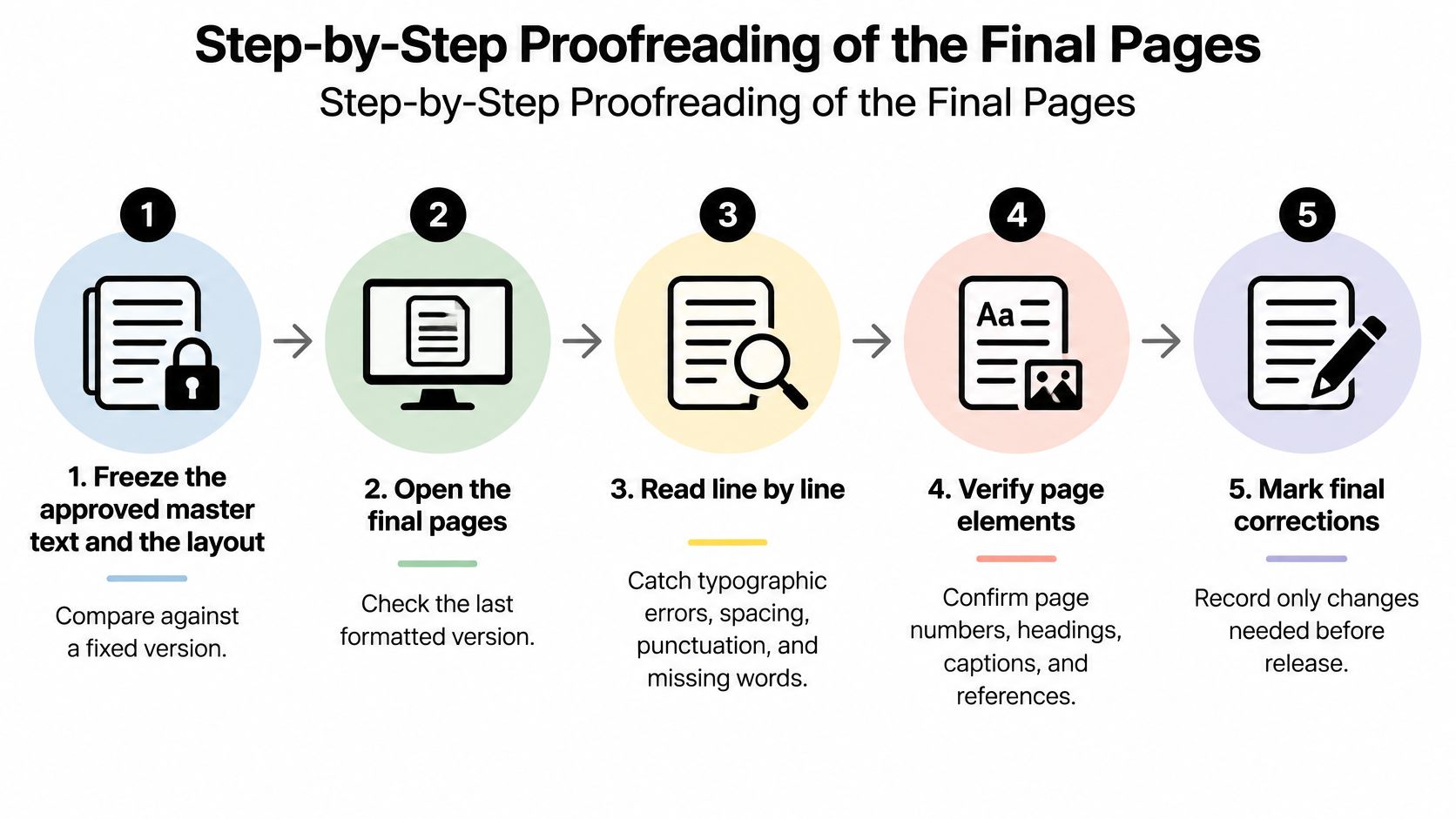
The Seven Steps in Working Order
- Freeze the approved master text and the layout. The proofreader needs a fixed version to compare against. The common slip is sending a "final" file, then editing it during the check.
- Open the final PDF and the master side by side. Check that no paragraph, sentence or table row has been dropped, because layout software can cut material when text reflows. Skimming only the PDF misses what's absent.
- Check pagination and page numbers against the table of contents and list of figures. Read the numbers, don't trust them. The typical slip is assuming an automatic contents page updated itself after your last change.
- Check cross-references, figure and table numbers, and captions. Every "see Figure 3.4" must point at the right object with the right caption. This is also where you confirm the back matter holds together, so it helps to follow a clear method for building and formatting your reference list accurately before this pass begins.
- Scan headings and chapter titles for mismatches and broken styles. A heading retyped during layout can drift from the contents entry or drop a level in the hierarchy.
- Inspect line breaks, widows, orphaned headings and margins. A heading stranded at the bottom of a page, or a single line carried to the next page, signals a layout defect examiners notice immediately.
- Mark each fix, then recheck only the changed pages. Correcting one line can repaginate everything after it, so verify the knock-on effects. Rechecking the whole document from scratch usually introduces new errors through fatigue.
The Readiness Gate
Treat this pass as a submission-readiness gate, not a general tidy-up. When a full pass produces no new marks, and the changed pages have been rechecked clean, the thesis is ready for the submission office.
Which Errors Each Service Catches and Misses
Say a citation appears in your text but never made it into the reference list. A copyeditor should catch it, because matching citations to entries is systematic work done on editable text. A proofreader working through a long PDF might catch it, but nobody should rely on that, because spotting an absence in a rendered list is far harder than checking pairs deliberately.
That asymmetry runs through proofreading vs copyediting. Use the table as a lookup, not a ranking.
Error Types and the Stage That Catches Them
| Error type | Copyediting | Proofreading |
|---|---|---|
| Inconsistent terms across chapters | Caught | Usually missed |
| Unclear or tangled sentence | Caught | Outside its job |
| Citation format mismatch | Caught | Partly caught |
| Citation missing from reference list | Caught | Sometimes caught |
| Ambiguous claim or wrong date | Flagged for author | Outside its job |
| Dropped paragraph or table row | Possibly missed | Caught |
| Wrong page number in contents | Outside its job | Caught |
| Broken cross-reference | Flagged | Caught |
| Caption or table mismatch | Flagged | Caught |
| Typo introduced by layout | Outside its job | Caught |
Errors That Sit Between the Two Stages
Some problems straddle the boundary. A broken cross-reference gets flagged during copyediting when the editor notices "see Section 4.3" pointing nowhere, but it's only caught at proof stage, when final numbering exists. A caption mismatch works the same way, since captions can be renumbered during layout after the editor last saw them.
An inconsistent term can also hide until late. If a heading gets reworded during formatting, the old term survives in the heading while the body uses the new one, and suddenly a consistency problem looks like a layout problem.
Following consistent academic writing guidelines for structure and presentation from the start reduces how many of these borderline errors appear at all, because fewer manual fixes get made during layout.
Neither Pass Guarantees the Other
A clean copyedit doesn't guarantee a clean proof. The text can be flawless while the PDF drops a table row. The reverse also holds, since a proofread document can have perfect pagination wrapped around tangled sentences nobody was asked to fix.
Each stage certifies something different, so passing one tells you nothing about the other.
When a supervisor returns a list of errors, sort each one against the table. Terminology and citation complaints mean the copyediting stage needs rerunning. Page numbers, captions and dropped material mean the proof needs another pass. That diagnosis saves you from paying twice for the wrong fix.
Using AI Tools Without Losing Accountability
AI tools are fast at surface work. They'll catch typos, flag inconsistent spelling and suggest clearer phrasing in seconds. The risk isn't that they find nothing. It's that they change things you didn't intend to change.
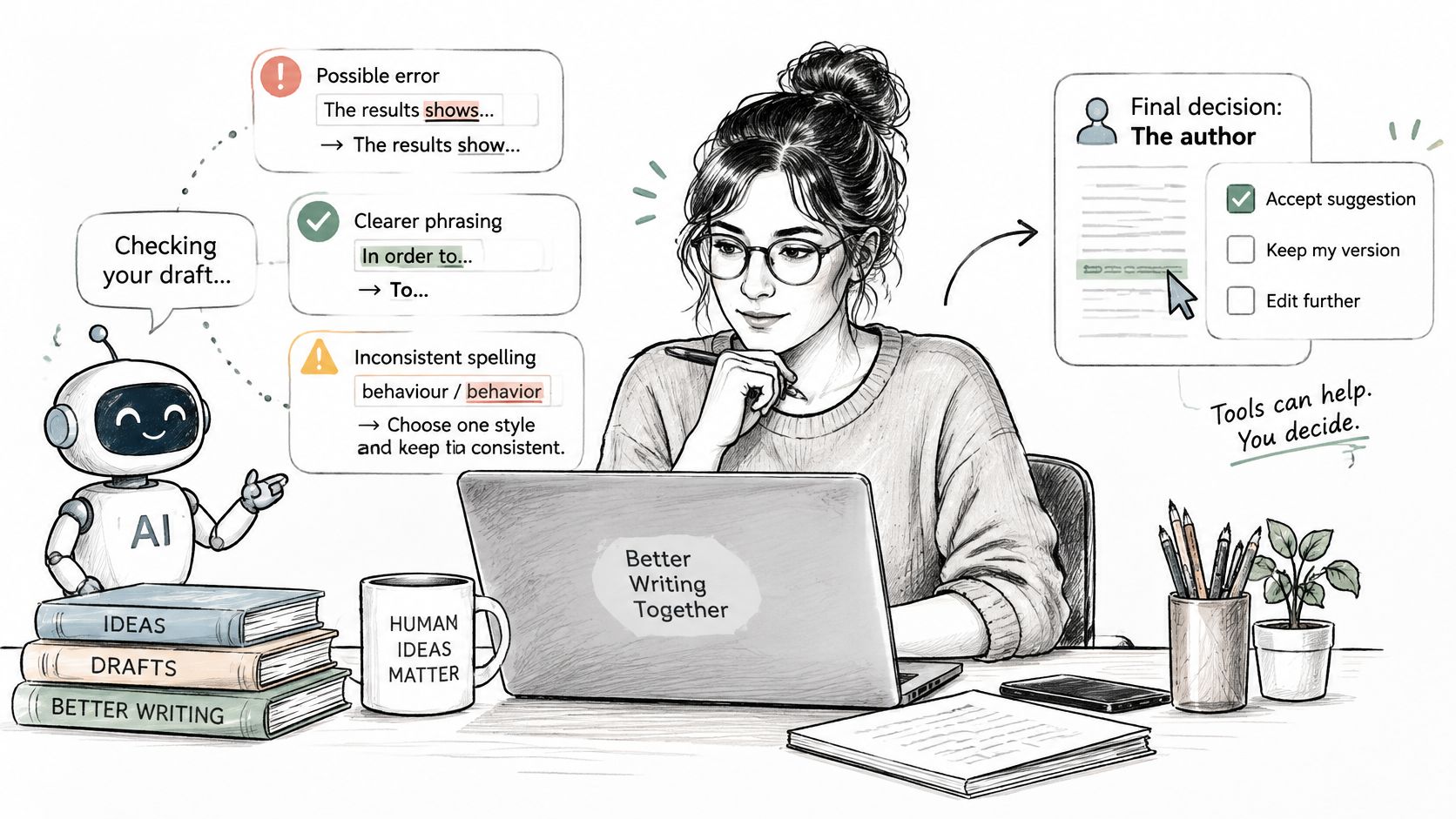
Recent academic-policy research reported in Cardiovascular Diagnosis and Therapy found that, among documented uses of generative AI in manuscript writing, editing accounted for 64% and proofreading for 27%. Writers already treat these as distinct activities, so the safeguards should differ too.
AI and Human Passes by Risk
| Option | What it does well | Main risk | Accountable |
|---|---|---|---|
| AI-assisted proofreading | Surface typos and inconsistent spelling | Misses layout defects that exist only in the PDF | Author |
| Human proofreading | Page numbers, dropped lines, captions, cross-references | Does not repair unclear prose or uneven terms | Author |
| AI-assisted copyediting | Clearer phrasing and fast grammar flags | Semantic drift, overwritten disciplinary terms, mishandled citations | Author |
| Human copyediting | Queries ambiguity and preserves authorial meaning | Still requires approval of every wording change | Author |
Where Tools Quietly Cause Damage
Semantic drift is the big one. A tool smooths "the intervention was associated with improvement" into "the intervention improved outcomes," and your careful non-causal language is gone. Tools also overwrite intentional disciplinary terms with everyday synonyms, mishandle citations by reformatting or inventing details, and create unwarranted confidence that facts have been checked when nothing has verified them.
A human copyeditor queries ambiguity instead of resolving it for you. A human proofreader inspects the rendered document, where broken references, missing symbols and table mismatches hide in layout that plain text never shows. For a useful comparison point on how automated feedback handles marking judgments, MasteryMind's AI marking features show how much human oversight still sits around automated assessment.
The Rule Set That Keeps You Safe
- Review every change individually. Never accept all edits in bulk, because drift hides in fluent sentences.
- Keep version history. You need to trace who or what changed a sentence, and roll it back.
- Disclose tool use where your university or journal requires it. Policies differ across institutions, publishers and funders, so check yours rather than assuming a universal rule.
- Never treat either service as plagiarism checking, source verification or research validation. Those are separate jobs with separate methods.
You sign the thesis. That means you own every sentence in it, including the ones a tool suggested.
Booking the Right Pass Before Submission
Once you know which pass your draft needs, book it against the submission date. These aren't interchangeable slots you can swap at the last minute, because each one depends on a different state of the document.
The Booking Sequence
- List every chapter and mark it drafted, copyedited or final. You can't schedule a whole-thesis pass until you know which chapters are ready. Our progress tracking shows how much of a thesis is left and whether the user is on track, which makes that judgment concrete.
- Confirm the style guide and your department's format rules before sending files. An editor working to the wrong citation style creates a second full pass.
- Send the copyeditor the approved master, not a mix of old drafts. Version confusion is a quiet source of delay, and it's worth checking your plan against the common mistakes that delay thesis submission before files go out.
- Schedule proofreading for the day the layout freezes, not before. Booking it earlier just means proofreading pages that will repaginate.
- After corrections, recheck only the changed pages, then the contents, list of figures and cross-references. Those are the elements a small fix can break.
If you're also preparing conference submissions alongside the thesis, the field-by-field abstract guidance from Planstone is worth a look, since abstracts get copyedited under the same rule. Lock the claims first, polish second.
A Practical Window
Book copyediting several weeks before submission, chapter by chapter as each one stabilises. Leave a gap after it for you to accept changes and answer queries, because that author pass takes longer than most students expect. Book proofreading in the final week, once formatting is frozen, and hold back at least one day for a second short proof of the changed pages only.
Today, write down your submission date, count backward to a layout-freeze date, and book the later pass against that freeze date. Everything else in the schedule hangs off those two dates.
Track each chapter from drafted to copyedited to final, count backward from your submission date to a layout-freeze date, and you'll never book the wrong pass again. Thesis Book Project gives you chapter tracking, milestone scheduling and progress visibility built for exactly that sequence, so visit today and set up your roadmap before you send a single file to an editor.
Related Articles
APA Multiple Citations: Formats, Order and Examples
You're revising a literature review, and the sentence finally says what you mean. Then you reach...
Thesis WritingHow Long Should a Thesis Proposal Be? Word Count Guide
Most doctoral admissions proposals run about 1,500 to 2,000 words, while internal thesis proposals o...
Thesis WritingDissertation Title Page: Required Elements and Layout Rules
Your dissertation title page is already being counted before anyone reads it. At many universities i...
Comments (0)
No comments yet. Be the first to share your thoughts.