How to Write a Problem Statement for Research That Works
Learn how to write a problem statement for research with a clear 4-part method, templates and a critique checklist to sharpen your thesis focus.
You've probably seen this supervisor comment already: “Interesting topic, but the problem isn't clear.” Or worse: “Too broad. Narrow it.”
That comment usually appears after a student has read widely, chosen a field they care about, and written several pages that still don't tell the reader one simple thing. What exactly is the study needed for? That's the job of the problem statement.
If you're trying to learn how to write a problem statement for research, don't start by sounding academic. Start by being exact. Examiners are not looking for a dramatic opening. They're looking for a short, defensible explanation of what is known, what is missing, and why your study deserves to exist.
A good problem statement makes the rest of the thesis easier. A weak one makes every later chapter harder.
Table of Contents
- Why Your Research Problem Statement Decides Everything
- What a Strong Research Problem Statement Contains
- How to Build Your Problem Statement With a Clear Method
- Step 1: Write one controlled context sentence
- Step 2: State the gap as an exact unknown
- Step 3: Prove the gap with evidence
- Step 4: Explain significance with the “so what” test
- The full 4-part pattern
- A simple drafting template
- A quick revision example
- Keep methods out until the problem is clear
- A revision checklist you can use in five minutes
- Templates and Real World Examples You Can Adapt
- Common Mistakes That Weaken Your Problem Statement and How to Fix Them
- Final Checklist and Next Steps for Your Research
Why Your Research Problem Statement Decides Everything
A student arrives with a proposal title that reads: “Social media and student well-being.” The topic sounds promising, but the meeting stalls within minutes. The supervisor asks what kind of social media use, which students, what measure of well-being, and what is still unknown in the research. The student has read plenty, but the study still has no clear center.
That is what a weak problem statement does. It gives you a subject area, but no research case.
Your problem statement works like the foundation line on a building plan. If that line is off, every wall above it shifts with it. In research, that means your questions spread too wide, your literature review collects material without clear limits, and your method starts to look chosen for convenience rather than fit.
A strong problem statement does more than introduce the topic. It tells the reader why this study needs to exist in this form, with this population, in this setting, at this time.
A topic is not a problem
Students often treat a broad subject as if it were already a research problem.
- Topic: remote learning in higher education
- Problem: despite extensive discussion of remote learning, one specific issue remains insufficiently understood in a defined group or setting, and that gap has consequences worth studying
That difference sounds small on paper. In a proposal, it changes everything.
A topic names the room. A problem statement points to the exact object in the room that requires examination. Examiners look for that level of precision because it shows that the project can be bounded, argued, and completed.
Here is a simple test. If your draft could support several very different studies, it is still describing a topic. If it leads the reader toward one clear line of inquiry, it is starting to function as a problem statement.
What examiners look for
When examiners read a proposal, they often judge its direction from this one part. They are usually checking for four things:
- Clarity. The problem is stated directly, not left for the reader to infer.
- Boundaries. The study has a clear setting, population, or condition.
- Support. The claim rests on evidence from the literature or observed practice, not personal interest alone.
- Importance. The writer can answer the question, “So what happens if this problem remains unresolved?”
That last point causes trouble for many students. They can describe a topic well, but they cannot yet explain why the gap matters. The “so what” test helps. If the only consequence is that the topic is interesting, the statement is still too weak. If the consequence affects theory, practice, policy, decision-making, or a clearly defined group, the argument becomes easier to defend.
As noted earlier, guidance from National University treats the problem statement as a central part of a proposal because it shapes the study's direction from the start (National University guidance on problem statements).
The difference between a broad interest and a defensible gap
Many weak drafts have enough reading behind them. What they lack is structure.
A useful way to check the paragraph is the four-part sequence used throughout strong proposals:
- Context. What field or setting are you working in?
- Gap. What remains unclear, under-studied, inconsistent, or unresolved?
- Evidence. What shows the gap is real?
- Significance. Why does that gap matter?
This sequence matters because it prevents a common mistake. Students often move from context straight to significance. They say a topic is important, then assume the study is justified. Examiners do not make that leap. They want to see the missing piece in between.
That is why the “so what” test belongs here. It separates a paragraph that merely describes an area from one that identifies a gap a study can reasonably address.
When your problem statement gets this structure right, later decisions become easier. Your research questions have clearer limits. Your literature review has selection criteria. Your method has a visible reason for being chosen.
What a Strong Research Problem Statement Contains
A strong problem statement works like the foundation line on a building plan. If that line is vague, every decision above it becomes harder to justify. Examiners look for one paragraph that tells them four things quickly: where the study sits, what is missing, what shows that the gap is real, and why the gap matters.
You can treat those four parts as a simple test: context, gap, evidence, and significance. If one part is missing, the paragraph usually slips into topic description. If all four are present, the reader can see a defensible research problem rather than just a broad area of interest.
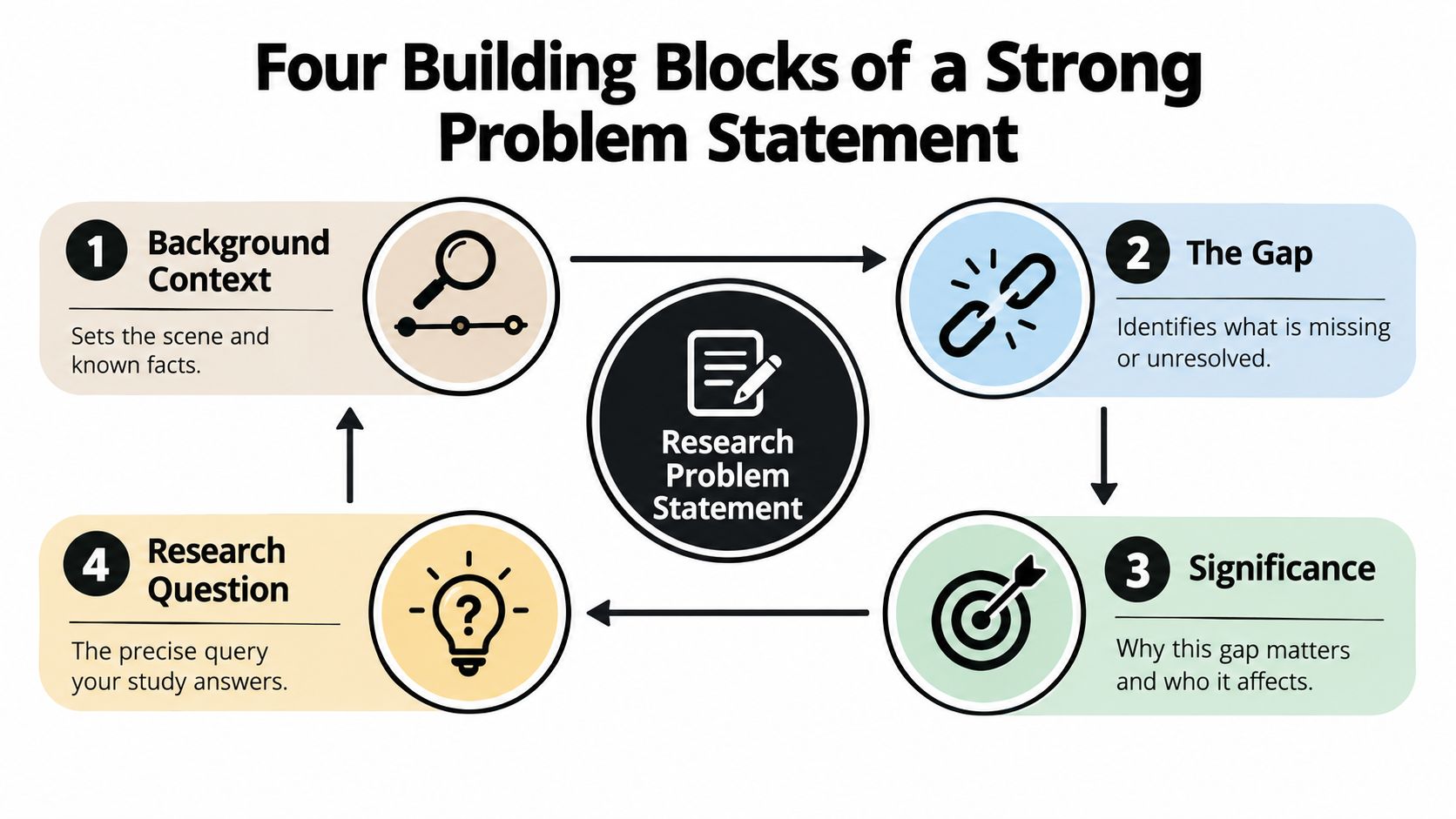
The four parts that carry the work
1. Context
Context places the study in a clear setting. It tells the reader what field, population, institution, practice, or environment you are discussing.
Good context is narrow enough to orient the reader without turning into a long introduction. A problem statement does not need the whole history of the field. It needs a controlled starting point.
For example:
In first-year university writing courses, instructors often rely on written feedback to guide student revision.
That sentence gives the reader a location, a population, and a practice. It sets the stage without trying to explain everything.
2. Gap
The gap is the missing piece. Many proposals weaken.
A topic is not a gap. “Online learning and student engagement” is a topic. A gap names what is still unknown, disputed, under-studied, or poorly explained within that topic.
Compare these:
- There are many issues with feedback in education.
- What remains unclear is how first-year students interpret written feedback comments when no follow-up discussion is available.
The second version gives the examiner something a study can investigate. It passes the first part of the “so what” test because it identifies a precise absence of knowledge.
3. Evidence
Evidence shows that the gap is real, not assumed. This is the part students often skip because they feel the problem is obvious.
Examiners do not mark “obvious.” They mark what you can support. Your evidence might come from recurring findings in prior studies, conflicting results in the literature, policy documents, institutional reports, or a pattern noted across credible scholarship. If your sources only show that the general topic matters, you still have not proved your specific gap.
A useful check is to ask: what would I cite after this sentence? If you cannot name the type of source that supports the gap, the problem may still be too loose. A focused guide to writing a literature review can help you gather studies that do more than summarize the topic.
If you also tend to blur the line between stating a research problem and arguing a position, these thesis statement writing tips can clarify the difference.
4. Significance
Significance answers the examiner's next question: why does this gap matter?
This is the “so what” test in full. A strong answer connects the missing knowledge to a consequence. Perhaps the gap limits teaching practice, weakens policy decisions, leaves a population poorly served, or prevents researchers from explaining inconsistent findings. Significance turns a narrow gap into a worthwhile study.
For example:
Without clearer evidence on how students interpret feedback comments, instructors may continue using response methods that do not support effective revision.
Now the paragraph does more than identify absence. It shows the cost of that absence.
A quick template you can test against your draft
Many strong problem statements can be reduced to this simple pattern:
- Context: In [setting or field], [established practice, condition, or trend].
- Gap: However, little is known about, it remains unclear whether, or existing research disagrees on [specific issue].
- Evidence: Prior studies, reports, or documented debate show [brief indication that the gap exists].
- Significance: [Practical, theoretical, or policy consequence].
That structure is easier to use than to memorize. It also helps you revise sentence by sentence.
What a problem statement is not
A problem statement is not:
- A broad topic label: “This study is about online learning.”
- A mini literature review: a dense paragraph full of source summaries
- A solution pitch: “This research will fix low engagement by introducing...”
- A moral complaint: “It is unfair that students struggle”
The tone should be calm and specific. Examiners usually trust a paragraph that defines a bounded problem, supports it with evidence, and explains its significance in plain terms.
How to Build Your Problem Statement With a Clear Method
You meet with your supervisor after a week of drafting. You say, “I want to study student feedback in online courses.” Your supervisor pauses, reads your paragraph, and asks the question examiners always ask in quieter language: What is the actual problem here? That moment is usually the difference between a topic and a defensible study.
A clear method helps. Instead of starting with your interest and hoping a problem appears, build the statement in four parts: context, gap, evidence, significance. Then apply one final check: So what? If your paragraph cannot answer that question in plain language, the problem is still too weak.
You do not need a long paragraph. In many proposals, one short paragraph is enough if each sentence has a clear job.
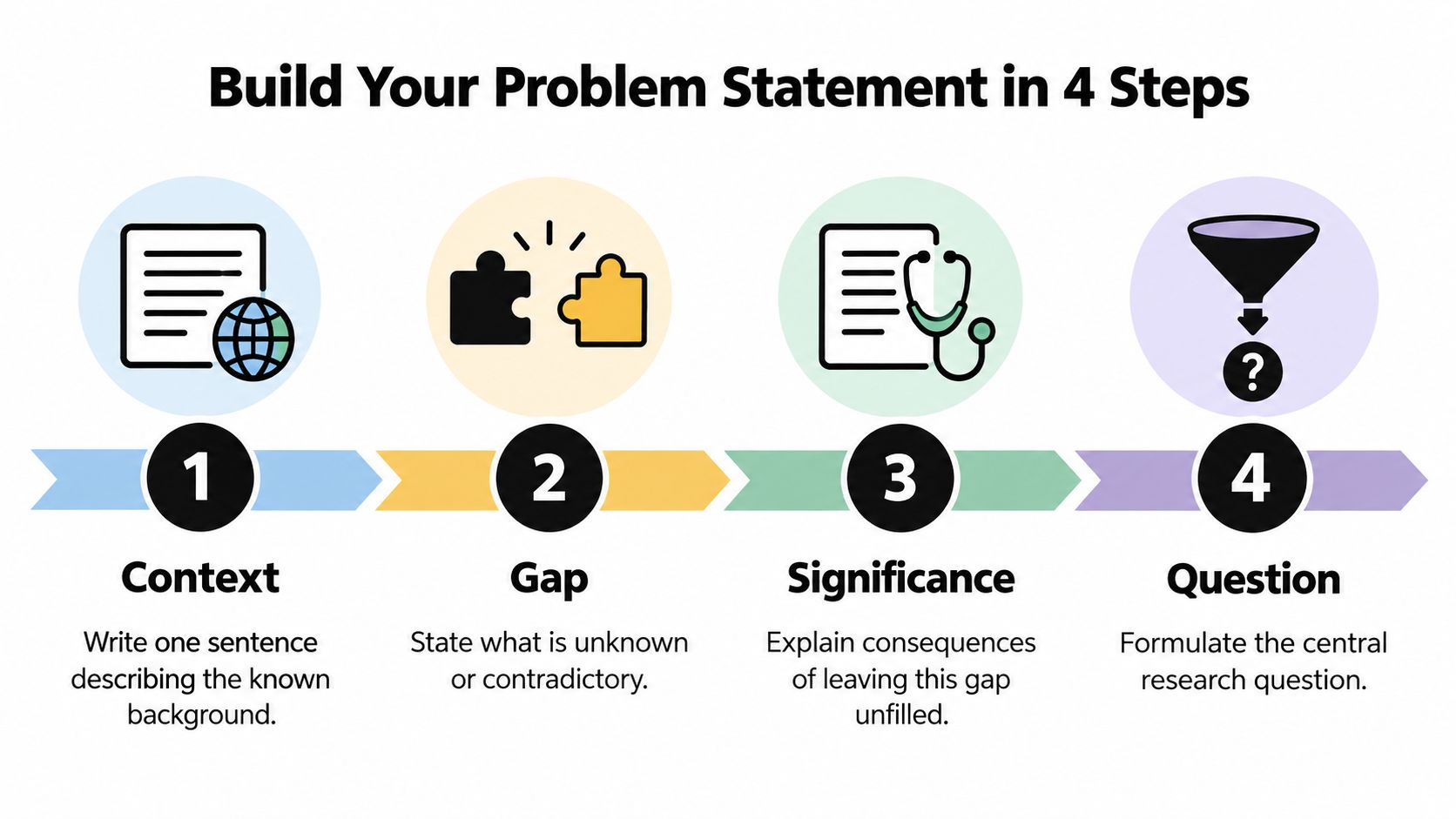
Step 1: Write one controlled context sentence
Start by locating the study in a specific setting. This sentence is the map. It tells the reader where the problem lives.
Weak: Technology affects education in many ways.
Stronger: In blended undergraduate courses, instructors increasingly rely on written feedback inside learning management systems.
The stronger version does three useful things at once. It names the setting, the people, and the practice. That gives the next sentence somewhere precise to land.
If your first sentence could fit almost any study in your field, it is still too broad.
Step 2: State the gap as an exact unknown
Now name what is not yet clear. This is the sentence many students soften too much.
Write the gap as a question the field has not answered well, not as a complaint that “more research is needed.”
For example:
However, it remains unclear how first-year students interpret brief digital feedback comments when they receive no verbal clarification.
That works because it points to a specific uncertainty. It does not announce a topic. It identifies a gap in knowledge.
A useful test is this: could a reader design a study question from your gap sentence alone? If yes, you are close.
Step 3: Prove the gap with evidence
Many drafts wobble. Students often jump from “little is known” straight to “therefore I will study it.” Examiners look for the missing middle. They want to see why you believe the gap is real.
Your evidence sentence can draw on:
- studies that examine the issue in different populations
- findings that conflict
- literature that stays broad and misses your bounded setting
- documented practice problems that research has not explained well
The point is not to show how much you have read. The point is to show why the gap is credible.
A practical comparison helps here. In project work, teams often define the issue before discussing solutions. The same discipline improves research writing. This article on how to align your team with clarity is written for business teams, but the core habit applies well to academic proposals.
A focused evidence sentence might read:
Existing research discusses feedback effectiveness broadly, but gives less attention to how novice students make sense of short, text-only comments in blended course environments.
Notice what this sentence does. It does not summarize five articles. It shows the limit in the existing conversation.
Step 4: Explain significance with the “so what” test
This final sentence turns an interesting gap into a worthwhile research problem.
Picture the paragraph as a chain. Context says where. Gap says what is unclear. Evidence says the gap is real. Significance says why the reader should care if the gap remains.
You can write:
Without a clearer understanding of that interpretation process, instructors may use feedback practices that seem efficient yet do little to improve revision quality.
This is the “so what” test in action. If the consequence is vague, the problem often is too. If the consequence is concrete, the study starts to sound necessary rather than merely interesting.
The full 4-part pattern
Put together, the paragraph looks like this:
In blended undergraduate courses, instructors increasingly rely on written feedback inside learning management systems. However, it remains unclear how first-year students interpret brief digital feedback comments when they receive no verbal clarification. Existing research discusses feedback effectiveness broadly, but gives less attention to how novice students make sense of short, text-only comments in blended course environments. Without a clearer understanding of that interpretation process, instructors may use feedback practices that seem efficient yet do little to improve revision quality.
Examiners usually read this kind of paragraph quickly because each sentence answers one predictable question.
A simple drafting template
Use this when your draft feels fuzzy:
- Context: In [setting], [group or institution] regularly [practice, condition, or trend].
- Gap: However, it remains unclear [specific unknown, disagreement, or underexamined issue].
- Evidence: Existing research [briefly show the limit, inconsistency, or omission].
- Significance: Without clearer evidence on this issue, [practical, theoretical, or policy consequence].
If your draft has all four parts, you have the bones of a solid problem statement. If one part is missing, the paragraph usually feels thin in a predictable way.
A quick revision example
Students often draft something like this:
This study focuses on digital feedback in higher education because online learning is growing and feedback matters for student success.
The sentence is true, but it does not yet present a research problem.
A revised version is stronger:
In blended undergraduate courses, written feedback through learning platforms has become common. However, it remains unclear how first-year students interpret short digital comments without verbal clarification. Existing studies discuss feedback effectiveness in general terms, with less attention to how novice learners understand brief text-only responses in blended settings. Without clearer evidence on that process, instructors may rely on feedback practices that appear efficient but do not support effective revision.
The revision works because each sentence performs a separate task. That is what supervisors mean when they say a problem statement should be “focused.”
A short video explanation can also help if you want to hear the structure explained differently:
Keep methods out until the problem is clear
Another common mistake is bringing in the method too early.
For example, this sentence is premature:
This study will use interviews to investigate student reactions to feedback comments.
That belongs after the problem statement, not inside it. First show that a real problem exists. Then explain how you will study it. If you can state the problem cleanly, choosing a method usually becomes easier because the boundaries of the study are already visible. If that next step feels unclear, this beginner's guide to the methodology chapter can help you connect the problem to an appropriate design.
A revision checklist you can use in five minutes
Read your paragraph and ask:
- Context: Have I named a specific setting, population, or practice?
- Gap: Have I stated an exact unknown rather than a broad topic?
- Evidence: Have I shown why the gap is real?
- Significance: Have I answered “so what?” with a concrete consequence?
- Scope: Does each sentence do one job, without drifting into literature review or methods?
If you cannot underline one sentence for each of the first four items, revise again.
Strong problem statements are usually trimmed, sharpened, and tested sentence by sentence. That is less glamorous than brainstorming a big topic, but it is the method that leads to proposals examiners can approve with confidence.
Templates and Real World Examples You Can Adapt
Templates help, but only if you understand what each line is doing. Students often copy a formula and produce something grammatically correct but intellectually empty. The useful way to use a template is to treat it as a scaffold for context, challenge, gap, and contribution.
Some recent academic guidance makes this distinction explicit. A stronger gap statement doesn't merely point at missing literature. It separates the field context from the unresolved challenge and from the contribution the study can realistically make (CASRAI guidance on writing a research problem statement).
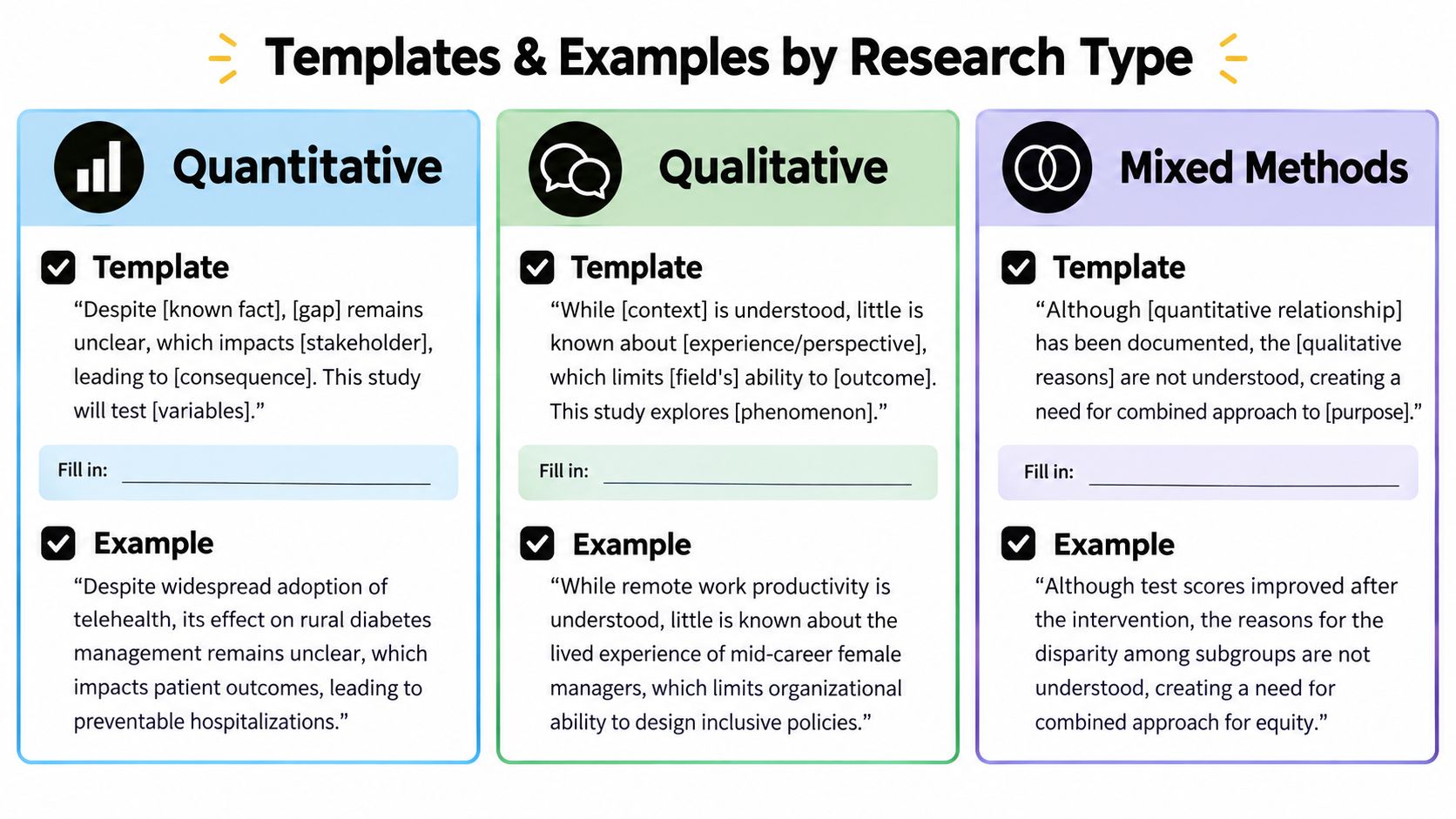
Template for quantitative studies
Use this when you are testing variables, relationships, or measurable differences.
Template
Although [established finding or current condition], [specific relationship, effect, or variable] remains unclear in [population or setting]. Existing research has not adequately explained or tested this issue in [bounded context]. As a result, [practical or scholarly consequence]. This study examines [variables or relationship].
Example
Although digital feedback is widely used in undergraduate teaching, the relationship between feedback brevity and student revision quality remains unclear among first-year students in blended writing courses. Existing research has not adequately tested this issue in courses where most feedback is delivered through text-only platform comments. As a result, instructors may not know whether short feedback supports or weakens student revision. This study examines the relationship between feedback length and revision outcomes in first-year blended writing modules.
Template for qualitative studies
Use this when the gap is about experience, meaning, perception, or process.
Template
While [what is broadly understood], little is known about how [group] experience or interpret [phenomenon] in [context]. Existing work tends to emphasize [dominant angle], leaving [specific perspective or process] underexplored. This limits understanding of [why that matters]. This study explores [phenomenon] from the perspective of [group].
Example
While digital feedback has been widely discussed in higher education, little is known about how first-year students interpret brief written comments in blended writing courses. Existing work tends to emphasize instructor practice and overall effectiveness, leaving the student meaning-making process underexplored. This limits understanding of why some feedback is acted on and some is ignored. This study explores how first-year students understand and respond to concise digital feedback.
Don't force numerical language into a qualitative problem statement. The gap may be depth of understanding, not measurement.
Template for mixed methods studies
Use this when the numbers show a pattern but don't explain it fully.
Template
Although prior research has identified [measurable pattern], the reasons, perceptions, or mechanisms behind that pattern remain insufficiently understood in [context]. This leaves [practical or theoretical consequence]. A mixed methods study is needed to examine both [quantitative element] and [qualitative element].
Example
Although prior research has identified uneven student uptake of digital feedback, the reasons behind that variation remain insufficiently understood in first-year blended writing courses. This leaves instructors with limited guidance on how to design feedback that is both efficient and usable. A mixed methods study is needed to examine both patterns of feedback use and students' explanations of how they interpret those comments.
A quick so what test
Before you keep any draft, ask these questions:
- Does it identify a specific unknown, not just a broad issue?
- Could a reader tell who or what is affected?
- Would the field lose something if this gap stayed unresolved?
- Does the final line suggest a contribution, not a promise to solve everything?
If the answer to any of these is no, the paragraph still reads more like a topic note than a defensible research problem.
Common Mistakes That Weaken Your Problem Statement and How to Fix Them
The same faults appear again and again in proposals. They look different on the surface, but they usually come down to three habits: writing too broadly, making claims without support, and smuggling in the solution before the problem has been established.
Guidance aimed at research students warns about these same failure modes and recommends narrowing the topic, gathering evidence before drafting, and deleting any sentence that proposes a fix too early (Research Prospect on common problem statement errors).
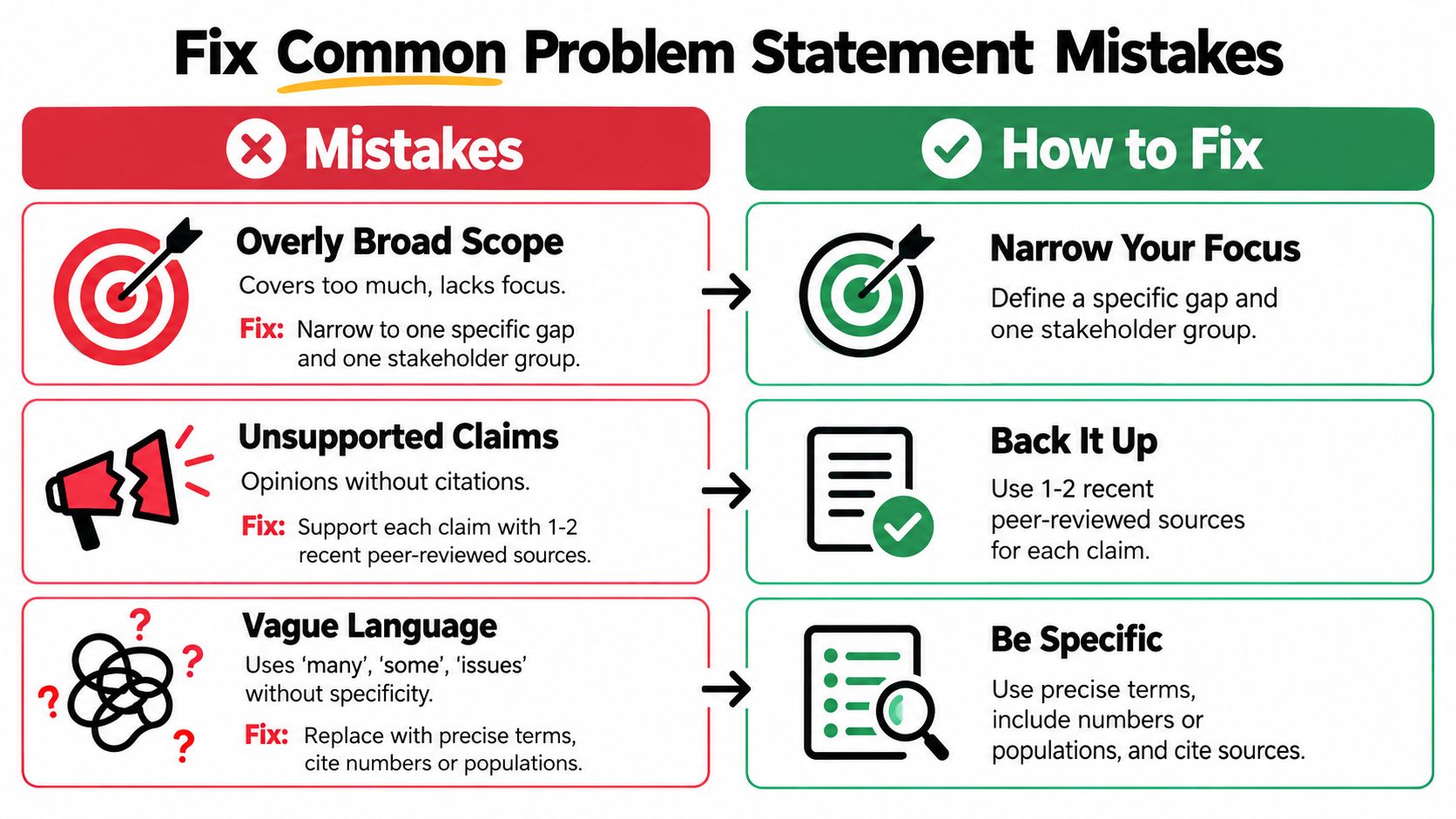
Mistake one: the scope is too broad
Weak draft:
University students face many challenges in online learning.
This gives you almost nothing to work with. Which students? Which challenges? Which aspect of online learning?
Better:
Among first-year students in fully online writing modules, it remains unclear how delayed instructor feedback affects revision decisions.
That rewrite narrows population, setting, and issue.
Mistake two: the claim has no proof
Weak draft:
Students often don't understand instructor feedback.
Maybe they don't. But the sentence reads like opinion unless your literature supports it.
Better:
Existing research identifies feedback as important to revision, but the interpretation of brief digital comments by novice students remains insufficiently explained in blended course settings.
Now the sentence sounds anchored to scholarship, not personal frustration.
Mistake three: the paragraph jumps to the fix
Weak draft:
Because feedback is unclear, universities should train staff to provide longer and more supportive comments.
That may become a recommendation later. It is not yet a problem statement.
Better:
Because the interpretation of short digital feedback remains unclear, instructors lack a sound basis for deciding how much explanation students need.
That sentence keeps the focus on the uncertainty.
When a problem statement starts prescribing interventions, it usually means the writer hasn't finished defining the problem.
A before and after table
| Weak version | Why it fails | Stronger revision |
|---|---|---|
| This study is about academic stress. | Topic only | The specific drivers of academic stress among first-year commuter students remain unclear in local university settings. |
| Social media harms teenagers. | Unsupported and value-laden | Existing research raises concern about adolescent social media use, but the effect of platform-specific use patterns on a defined outcome remains unclear in a bounded group. |
| Schools should use better technology tools. | Solution before problem | It remains uncertain how current classroom technology practices affect a specific learning process in a specific educational setting. |
If you want a broader self-audit of proposal weaknesses that tend to slow submission, this guide on common mistakes that delay thesis submission is worth reviewing.
A ruthless self-edit routine
Use this when revising your paragraph:
- Circle the population: If you can't name it, the scope is probably loose.
- Underline the exact gap: If you only find topic words, the problem isn't stated yet.
- Check each claim for support: If a sentence depends on opinion, rewrite it.
- Delete solution language: Save recommendations for later chapters.
- Cut the second problem: One statement, one central issue.
Most drafts improve quickly when the writer removes ambition and adds precision.
Final Checklist and Next Steps for Your Research
A strong problem statement is brief, but it should survive a hard reading. Before you send your draft to a supervisor, test it like an examiner would.
The checklist I'd use in supervision
Ask these questions:
- Is the problem explicit? The reader should see the issue in one reading.
- Is it evidence-based? The paragraph should prove, not merely assert.
- Is it narrow enough for one study? A thesis needs boundaries, not a world problem.
- Does it pass the so what test? The consequence of leaving the gap unresolved should be visible.
- Does it avoid premature solutions? The statement should justify the study before prescribing action.
- Can the research question grow directly from it? If not, the wording is still too loose.
What to do after the statement is solid
Once the problem statement works, use it as a control document. Your research question should come directly from the gap. Your objectives should come directly from the question. Your literature review should collect only the sources needed to explain the context, support the gap, and justify the significance.
That's also when chapter planning becomes easier. You're no longer managing a broad interest area. You're managing a defined inquiry.
A good problem statement doesn't guarantee an easy thesis. But it does remove one of the most common reasons proposals drift, stall, or keep getting returned with the same comment: “Still too vague.”
If you can write four clean parts, prove the gap, and answer the “so what?” question, you'll already be ahead of many early drafts supervisors see.
If you want help turning a clear problem statement into a workable thesis plan, Thesis Book Project gives students a structured roadmap from proposal to submission, with chapter tracking, milestone planning, and progress visibility built for thesis work. It's especially useful when you've defined the research problem but need a practical system to keep your questions, chapters, and deadlines aligned.
Related Articles
Qualitative vs Quantitative Research: Which Is Right for Your Thesis
Few decisions shape your thesis more than the choice between qualitative and quantitative research....
Research MethodsThe Methodology Chapter Explained for Beginners
The methodology chapter is where many otherwise strong dissertations lose marks, usually because stu...
Comments (0)
No comments yet. Be the first to share your thoughts.