How to Write a Thesis Introduction That Works
Learn how to write a thesis introduction that engages readers and sets up your research. Practical steps, templates, and expert tips included.
You're staring at a blank document with a dozen tabs open, a working title that keeps changing, and a vague sense that the introduction should somehow summarize your entire project. You start writing background, add a few citations, then realize several paragraphs could belong to almost any thesis in your field. The page grows, but the argument doesn't.
Learning how to write a thesis introduction becomes much easier when you stop treating it as a ceremonial opening. A strong introduction is a controlled argument. It gives the reader enough context to understand the problem, enough evidence to accept the gap, and enough precision to see exactly what your study will do.
Table of Contents
- Why Your Thesis Introduction Matters More Than You Think
- The Three-Move Structure That Makes Introductions Work
- Building an Evidence-Controlled Argument
- Knowing How Much Context Is Enough
- Using AI Without Weakening Originality or Accuracy
- Checking Your Introduction Before You Move Forward
Why Your Thesis Introduction Matters More Than You Think
The introduction carries unusual responsibility because it establishes the logic that every later chapter must fulfill. It answers the reader's first substantive question: why was this study undertaken? The methods chapter explains how you investigated the problem, the results chapter presents what you found, and the discussion explains what those findings mean. The introduction earns the right for those chapters to exist.
This function became clearer as scientific writing moved toward standardized research narratives. The history of the IMRAD format shows that the structure was not found in sampled articles in 1935, began appearing during the 1940s, exceeded 10% of articles in all examined journals by 1950, and reached more than 80% of sampled articles by the 1970s. By the 1980s, it was the only pattern used for original papers in the journals studied. The pattern developed gradually, with an IMRAD-like structure traceable to Louis Pasteur's 1876 work on fermentation, and American national standards in 1972 and 1979 helped reinforce it.
The introduction is a promise
Think of your introduction as a contract with the examiner. If you promise to investigate a defined problem among a particular population, using a particular conceptual lens, the rest of the thesis must deliver that investigation. If the introduction announces questions that your method cannot answer, the weakness appears before the reader reaches your data.
A useful introduction therefore narrows deliberately:
- Context: What wider field or problem does the reader need to understand?
- Prior knowledge: What has scholarship already established, and where does it disagree?
- Gap: What remains unresolved, limited, or overlooked?
- Purpose: What will this thesis investigate?
- Contribution: What will the study add, and within what boundaries?
The common failure is not a lack of information. It's a lack of selection. Students often include every interesting source they've found, turning the opening into a miniature literature review. The result may sound informed, but the reader still can't identify the precise reason for the study.
Practical rule: Every paragraph in the introduction should make the research problem more necessary, more specific, or more answerable.
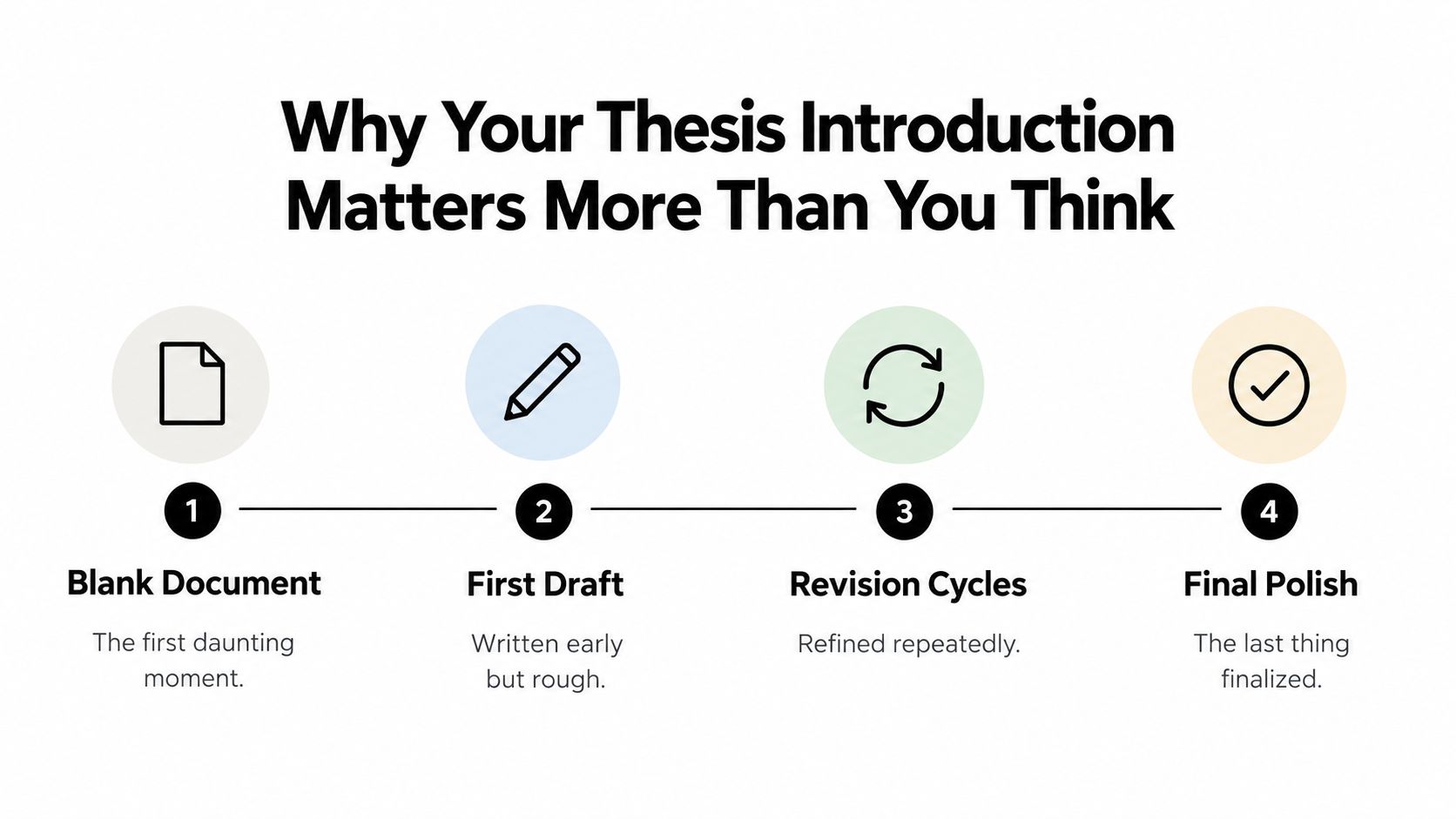
Drafting early is useful because it exposes an immature research question. Finalizing early is risky because your argument, method, and scope usually change as the project develops. Write a working version to guide the research, then revise the introduction after the central chapters have stabilized.
The Three-Move Structure That Makes Introductions Work
The Create a Research Space, or CARS, model gives you a reliable way to organize the argument. A corpus analysis of 10 introductions found all three moves in 100% of the texts, regardless of author experience, supporting the model as a diagnostic framework rather than a rigid paragraph formula. The CARS model research also identifies topic generalization as important in the first move, explicit gap indication in the second, and a clear announcement of the present research in the third.
Before writing polished prose, complete this sentence:
What is known → what is insufficient → what this thesis will do.
That chain becomes the backbone of your introduction.
Move one establishes the territory
Begin by defining the research territory and showing why it deserves attention. Don't list sources one by one. Synthesize them into a short account of what the field currently understands.
For example, instead of writing a sequence of summaries about feedback in academic writing, you might establish that feedback is widely used to support revision, that researchers have examined its effects on writing development, and that findings differ depending on the type of feedback and the context in which students receive it. The paragraph ends by preparing the reader for a limitation, not by closing the topic.
Move two establishes the niche
The second move identifies what the existing work doesn't adequately explain. A credible niche might involve a contradiction between findings, a population rarely examined, a methodological limitation, an overlooked setting, or a question that previous studies have raised but not answered.
“Little research exists” is usually too weak. Explain what is missing and why its absence matters. If prior studies examine feedback outcomes but don't explain how thesis writers interpret that feedback, the gap concerns understanding and process, not just the topic of feedback.
This is also where a carefully developed research problem statement can keep the gap from becoming a broad subject label.
Move three occupies the niche
The final move states what your thesis will do. Include the purpose, research questions or hypotheses, contribution, and relevant boundaries. You may also preview the thesis structure if your department expects it.
The transition should feel inevitable:
- Existing research establishes the importance of the phenomenon.
- That research leaves a specific question unresolved.
- This thesis addresses the question through a defined study.
Your purpose statement should name the design or approach when that detail helps the reader understand the investigation. The method itself belongs later, but the introduction should make the study's boundaries visible. For guidance on connecting the rationale to writing a rigorous methods section, keep the research questions and proposed evidence aligned from the beginning.
Building an Evidence-Controlled Argument
A generic overview asks, “What can I say about this field?” An evidence-controlled introduction asks, “What must the reader know before accepting this research problem?” That change in question improves both relevance and structure.
The most efficient way to make the change is to write backward. Start with the purpose of the study and the research questions, then work toward the opening context. Specify the constructs, population, setting, and timeframe that define the investigation. Only after those elements are clear should you decide which background sources belong.
Start with the destination
Write a provisional purpose statement such as:
This thesis examines how [construct] operates among [population] in [setting], focusing on [defined aspect of the problem].
Then write the questions that the study can answer. If your method uses interviews, don't ask a question that requires population-wide measurement. If your study examines a specific setting, don't write an introduction that implies universal conclusions.
A backward-writing worksheet can include:
| Element | Question to answer |
|---|---|
| Problem | What specific condition or uncertainty requires investigation? |
| Population | Whose experience, behavior, texts, or data will be studied? |
| Setting | Where does the problem occur? |
| Timeframe | What period or stage does the study cover? |
| Construct | What exactly will be observed, interpreted, or compared? |
| Contribution | What will become clearer after the study? |
Give every citation a job
For each source, record its role before placing it in the draft. A citation may define a key concept, establish broad agreement, document disagreement, reveal a limitation, or justify a methodological choice. If you can't explain the source's function, it probably doesn't belong in the introduction.
This approach prevents citation accumulation. A paragraph with several references can still be weak if the sources all perform the same function or if none directly supports the sentence being made. Conversely, one carefully chosen source may be enough when it establishes a definition or documents a specific limitation.
The rhetorical analysis of student introductions distinguishes early moves such as claiming centrality and reviewing prior research from later moves such as indicating a gap, stating aims, explaining value, and previewing structure. In a study of 49 student introductions, writers generally used early contextual moves, but some omitted later rhetorical functions and all omitted the final move identified in that model.
A reader shouldn't have to infer your purpose from the background. State it, then make the preceding evidence earn its place.
Remove material that doesn't advance the proof
Read each paragraph and ask what would become harder to understand if you deleted it. Remove material that only demonstrates your reading, repeats a point already established, or reports findings unrelated to the questions.
This doesn't mean the introduction should be bare. It means every included detail should perform argumentative work. The best introductions often feel selective because the writer has separated essential context from material that belongs in the literature review, theoretical framework, or methods chapter.
Knowing How Much Context Is Enough
Students often ask for a fixed introduction length because a fixed number feels safer than judgment. That approach fails across disciplines. The Australian National University guidance on thesis introductions notes that background may range from a short treatment to more than 20 pages, depending on the objectives of the research. The relevant question isn't whether your introduction matches someone else's page count. It's whether the scope is justified by the problem.
Use an inclusion test
Keep background material when it does at least one of four jobs:
- Establishes the problem: It shows the condition, debate, or phenomenon that motivates the study.
- Defines an essential concept: It clarifies a term that the reader must understand to follow the questions.
- Demonstrates the gap: It shows what scholarship has examined and what remains unresolved.
- Prepares the study's rationale: It explains why your population, setting, framework, or approach is appropriate.
Move material elsewhere when it merely summarizes a source, provides interesting historical detail, or discusses findings that don't affect your research questions. A paragraph can be accurate and still be irrelevant to the introduction.
Let the discipline shape the emphasis
A humanities thesis may need more interpretive and historical context because the significance of a text depends on its intellectual, cultural, or formal setting. An empirical thesis may need less broad history and more precision about operational definitions, variables, population, and study rationale.
The same topic can therefore require different openings. A literary study may establish a critical debate before presenting an underexamined interpretation. A chemistry thesis may define the material or process, identify a limitation in existing findings, and specify the experiment. A social science thesis may connect a social condition to a theoretical dispute and then narrow to a population or setting.
The decision framework remains stable even when the content changes:
Include what the reader needs before accepting this specific research problem, not everything you know about the subject.
A genuine gap is also narrower than an unexplored topic. A research gap guide can help distinguish “this subject has not been studied” from a defensible explanation of what existing work cannot yet explain and why that limitation matters.
Separate introduction and literature review functions
The introduction should orient and justify. The literature review should examine the scholarship in greater depth, compare sources systematically, and develop the theoretical or conceptual foundation. If a paragraph could be removed without affecting the reader's understanding of your problem and purpose, it may belong in the literature review instead.
Using AI Without Weakening Originality or Accuracy
AI tools can help with surface-level writing, but the introduction contains intellectual decisions that shouldn't be outsourced. Your central problem, research gap, and contribution must come from your reading and reasoning. A fluent paragraph generated from an incomplete literature set can make an unsupported gap sound authoritative.
A 2026 Goethe University Frankfurt survey reported that 89% of students used tools such as ChatGPT or DeepL in academic writing, particularly for brainstorming, getting started, and language revision, as reported in the university's survey on studying in the age of artificial intelligence. That adoption makes clear boundaries more useful than blanket rules.

Use AI for controlled support
Low-risk uses include generating an outline from your own notes, identifying repeated phrases, suggesting clearer transitions, or checking whether a paragraph follows the order of your argument. You remain responsible for the claims, sources, interpretation, and final wording.
Higher-risk uses include asking a tool to invent a literature gap, summarize papers it hasn't accessed, generate citations, or write a contribution statement from a vague prompt. Those tasks transfer the central reasoning of the thesis to a system that may produce plausible but unsupported prose.
A practical workflow looks like this:
- Build the evidence base yourself. Read the sources and record page-level notes where appropriate.
- Write the problem and questions manually. Make the intellectual choices before asking for language help.
- Use AI only on supplied material. Ask it to reorganize or clarify your notes, not to supply scholarship.
- Verify every claim against the original source. Open the paper, check the wording, and confirm that the source supports your sentence.
- Review institutional policy. Disclosure and permitted uses vary by department and university.
The separate survey of MBA thesis students cited in the brief found that many participants perceived improvements in argument clarity, revision quality, and writing speed, while concerns about accuracy and source handling remained widespread. That combination captures the trade-off: AI can reduce friction without improving the underlying research judgment.
For a focused explanation of whether Turnitin can actually detect ChatGPT, remember that detection is not the core academic-integrity issue. The more important question is whether the submitted introduction represents your own reasoning and whether every cited claim is verifiable.
Use the video below as a practical prompt for evaluating AI-assisted academic writing, then compare its suggestions with your institution's rules.
Checking Your Introduction Before You Move Forward
A polished introduction can still fail if its parts don't align. Before sending it to a supervisor, test the argument rather than checking only grammar. Read the final paragraph first, then work backward through the gap and context. The logic should become easier to understand as you move toward the opening, not more confusing.
Run these five yes-or-no checks:
- Is the problem specific? Can you identify the population, phenomenon, setting, or debate without relying on broad phrases?
- Is the gap supported by sources? Does the literature demonstrate what remains unknown, limited, contradictory, or underexamined?
- Do the questions answer the gap? If you read only the problem statement and questions, would the connection be obvious?
- Are key terms operationally clear? Would a reader understand how central constructs are used in this thesis?
- Can the reader predict the contribution? Does the final paragraph explain what the study will add without promising more than it can deliver?
Calibrate citations without chasing a quota
Citation density can help you diagnose an introduction, but it isn't a target to hit mechanically. A study of master's theses reported approximately 13.37 citations per writer in agriculture and 13.53 in chemistry. An analysis of undergraduate theses found 3,131 citations across 275,418 words in introduction and literature-review chapters, equivalent to 11.36 citations per 1,000 words. These figures come from the research on citation density and citation form, and they should be treated as reference points rather than rules.
The same research found that 818 of 5,201 citations, or 15.7%, were integral citations that named the researcher in the sentence, while 4,383, or 84.3%, were non-integral citations placed in parentheses or separated from the prose. That pattern supports a useful default: write in your own analytical voice and use parenthetical citations to support claims. Name authors directly when comparing theories, methods, or competing findings.
Do a final alignment read
Check that the purpose statement matches the research questions, the questions match the method, and the scope matches the evidence you can access. Then compare the introduction with the latest version of your literature review and methods chapter. If the study changed during the project, revise the introduction rather than forcing the later chapters to honor an outdated promise.
Use guidance on avoiding plagiarism and referencing correctly to check attribution, paraphrasing, and citation consistency. Then read the chapter aloud. Awkward transitions often reveal the exact point where the literature review stops producing the gap, or where the gap stops justifying the study.
The strongest introduction doesn't overwhelm the reader with knowledge. It controls the reader's path from significance to problem, from problem to gap, and from gap to a researchable contribution.
Thesis Book Project helps students plan and track thesis work from proposal through submission, with chapter tracking, backward-planned milestones, source organization, and supervisor progress sharing. Visit Thesis Book Project to turn your introduction, research questions, and chapter revisions into a structured workflow.
Related Articles
7 Literature Review Research Proposal Examples
A literature review can be the part of a proposal that proves a study is necessary, not merely the p...
Research MethodsLiterature Review Methods: A Clear Guide for Researchers
You've opened so many papers that your browser has become a second desktop. One article defines...
Research MethodsWhat Is a Theoretical Framework in Research
You've read the definitions, highlighted the key theories, and still can't explain what your...
Comments (0)
No comments yet. Be the first to share your thoughts.