APA Format for a Website with No Author: How to Cite It
Learn APA format for a website with no author, with reference and in-text examples for organizations, undated pages and titles.

You've found a useful statistic, your paragraph's ready, and now you're staring at a reference entry with no author to put first. Don't leave that slot blank or paste in a domain name. APA format for a website with no author follows a clear order, and once you check for an organization first, the rest falls into place quickly.
Table of Contents
- Why an Unsigned Web Page Needs Its Own Rule
- Which Author to Use When a Page Has No Byline
- Handling Missing Dates and Retrieval Dates
- Reference Entry Template for an Unsigned Webpage
- In-Text Citations When the Title Takes the Author Slot
- Run This Check Before You Submit Your Paper
Why an Unsigned Web Page Needs Its Own Rule
You're drafting late, you scroll to the top of a strong webpage for a byline, then to the bottom, and there's no name anywhere. The instinct most students follow is to drop the author element entirely or copy the domain into that slot. Both choices break the match between your in-text citation and your reference list, so your reader can't trace the source.
That problem is exactly why current rules exist. The seventh edition of the APA Publication Manual was published on October 1, 2019, and the APA webpage and website references guidance notes the manual contains more than 140 sample references covering traditional sources and newer materials, including webpages, websites, and social media. APA 7 formalized how to handle pages that lack personal bylines, show corporate responsibility, or change over time.
A Webpage Is Not a Whole Website
A specific webpage you quote or paraphrase needs its own reference entry and a matching in-text citation. A general mention of an entire website, by contrast, can often be handled in your text without a reference-list entry. Confusing those two is a frequent slip, and it leads students to cite a homepage when their evidence came from one page deep inside the site.
APA 7 also clarified that the website name normally appears in a reference when it's different from the group author, while you avoid repeating it when the organization and website share the same name. That detail matters once you start building entries.
Practical rule: Never start by asking what to do with a missing author. Start by asking who is responsible for this page.
The logic you'll use has three levels. First, look for a responsible organization. Second, if no person or group is identifiable, fall back to the page title. Third, check the date and use n.d. only when no date is supplied. You'll leave with a lookup table for the author position, a decision path, a reference template, in-text rules, date handling, and a final checklist.
Which Author to Use When a Page Has No Byline
Find your case in the table first, then confirm it with the steps below it. APA follows a hierarchy rather than omitting the author, as the APA guidance on missing reference information explains. If an organization is responsible, that group goes in the author position. If neither an individual nor an organization is identified, the webpage title moves there instead.
| Page type | Author position | Reference pattern |
|---|---|---|
| Named individual | Surname and initials of the author | Surname, A. A. (2024, April 10). Title of the page. Website Name. URL |
| Organization or agency | Group name as author | World Health Organization. (2024, April 10). Title of the page. Website Name. URL |
| Website is also the group author | Site name in author slot only, not repeated | Harbor Water Trust. (2024, March 3). Title of the page. URL |
| No author, dated | Page title in italics | Coastal Cleanup Efforts. (2012, June 4). Harbor Water Trust. URL |
| No author, undated | Page title in italics, n.d. for date | Coastal Cleanup Efforts. (n.d.). Harbor Water Trust. URL |
Walk Through the Decision in Order
- Check for a named person. Look at the byline and the top of the page, including small text under the heading.
- Check for a responsible organization. Look at the footer, logo, and About page for a university, ministry, nonprofit, company, office, or department that publishes the content.
- Decide what the website name is doing. Is it only a host, or is it the responsible group itself? A domain name alone never identifies an author, so don't turn part of a URL into a name.
- Use the title last. Only when no person or organization is identifiable should the webpage title move into the author position.
Say you're citing a city parks page about trail closures. No person is named, but the page is signed by the Parks and Recreation Department. That department is your author. You don't use the city website name as a substitute, and you don't promote the page title, because a responsible group is right there.
The slip to avoid is treating every unsigned page as authorless. That shortcut removes traceability and produces an inaccurate reference, because your reader sees a title where an accountable organization should be. In-text citations follow the same hierarchy, using the organization's name when one exists, or a shortened title and year such as ("Coastal Cleanup Efforts," 2012) when it doesn't.
If you can name who would answer questions about the page, you've probably found your group author.
Handling Missing Dates and Retrieval Dates
Look closely at the page before you copy any date, as in the workspace shown here.

Use the most specific date clearly attributable to the page's content, not merely a copyright year in the site footer. The APA author-date citation principles support building the citation from the page-level date, exact webpage title, site name, and stable URL. If the page says Updated March 2024 and the footer reads 2019, use March 2024. The footer belongs to the whole site, not to that page.
Work in sequence. Look for an updated line, then a date near the byline or heading, then a footer date that clearly matches the content, and only then consider n.d. Don't invent a date, infer one from the URL, or guess a year from a copyright notice.
This short video walks through the same date-checking habit before you apply it below.
When n.d. and Retrieval Dates Apply
For an undated page, use n.d. in both the reference entry and the parenthetical citation, as in ("Coastal Cleanup Efforts," n.d.). A static page usually needs no retrieval date. Add one only when content is designed to change continually and isn't archived, such as a live reference page, a wiki, or a continually updated database entry.
A fixed article announcing a past cleanup, with a clear publication date, doesn't need a retrieval date. A live water-quality dashboard that updates its readings and keeps no archive does. That distinction keeps you from adding retrieval dates to every web source out of caution.
Reference Entry Template for an Unsigned Webpage
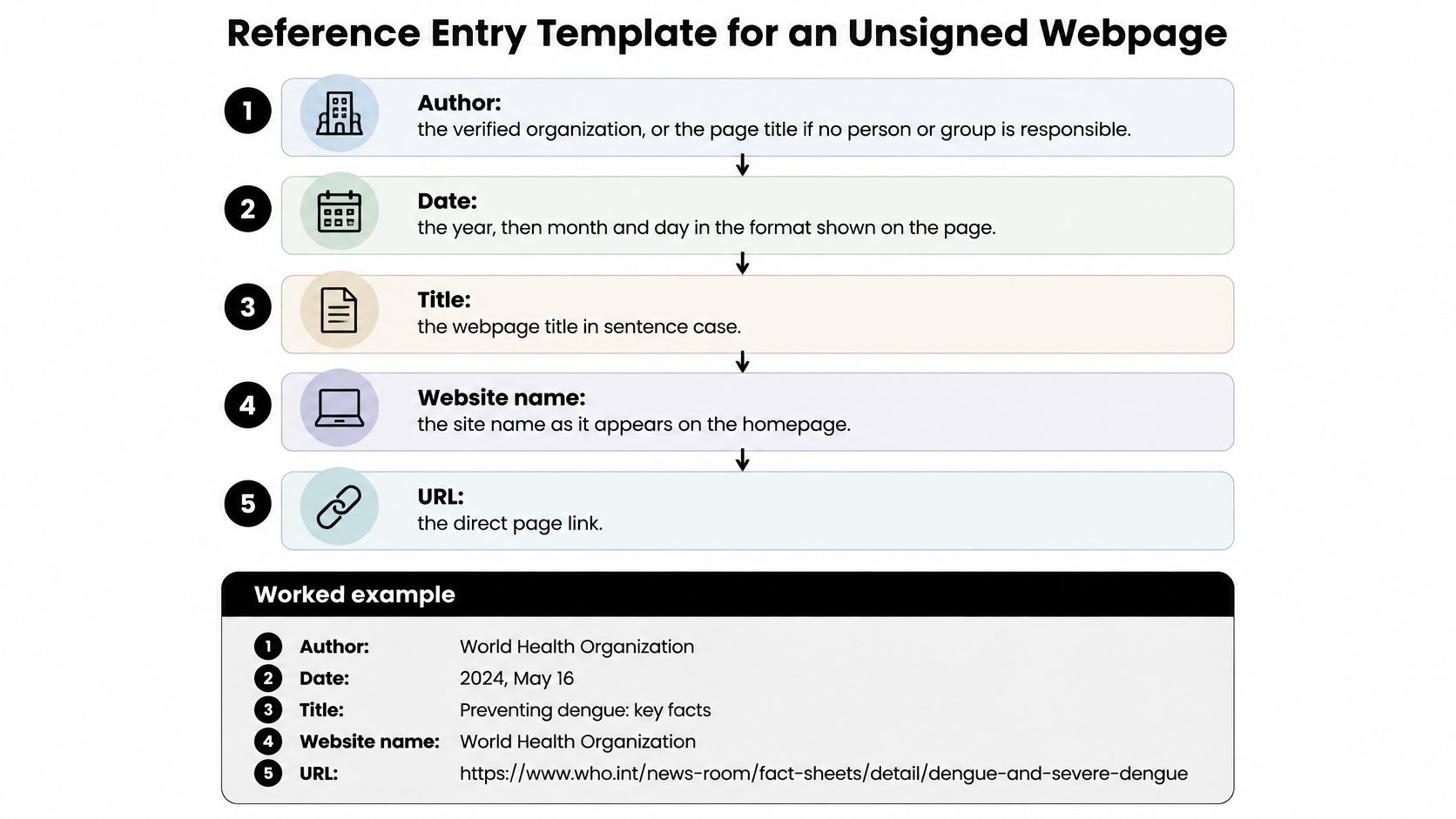
Build the entry in five steps, in this order. Each element sits where it does for a reason, and the opening element is the one your reader uses to find the source alphabetically.
- Author. Use the verified organization, or the page title if no person or group is responsible. Verify the page is unsigned first, rather than authored by an organization or government agency.
- Date. Give the year, then month and day in parentheses, using the most specific date available. Use n.d. when none exists.
- Title. Give the exact webpage title in italics, with sentence-case capitalization and a period after it. Capitalize only the first word, the first word after a colon, and proper nouns.
- Website name. Include it only when it differs from the author. If the site is the group author, don't repeat it here.
- URL. Give the stable address of the specific page, not the homepage.
The Purdue OWL APA formatting and style guide gives the pattern as Title of webpage. (Year, Month Day). Website Name. URL. It also warns against treating Anonymous as a default author. Use that word only when the work is explicitly signed that way.
The infographic below lays out those five elements in sequence.
One Worked Example
An unsigned, dated page looks like this:
Coastal Cleanup Efforts. (2012, June 4). Harbor Water Trust. URL
Now change one fact. If Harbor Water Trust published and stands behind that page as an organization, it moves to the author slot, the title follows the date, and you don't repeat the site name. Same page, different opening element, because responsibility changed the entry.
If you're also formatting journal sources in the same paper, our guide on how to cite articles in a research paper covers the parallel decisions for those entries. Our blog articles are written by human writers and reviewed by our editorial team before publication, so the steps stay consistent across guides.
Finally, alphabetize an unsigned entry by the first meaningful word of its title, ignoring an initial A, An, or The. A title beginning with The sorts under its second word, which is where your reader will look for it.
In-Text Citations When the Title Takes the Author Slot
A corporate report and an unsigned page can look the same if you only hunt for a personal byline. Check the organization first. If a government office, a university, or another group wrote the page and stands behind it, that group is the author. Cite the organization by name so the reader sees who is responsible in the sentence. The slip most students make is skipping that check and shortening the title anyway, which hides the group that owns the page.
Use the title in the citation only when no person and no organization can fill the author slot. The pattern is a shortened title in double quotation marks, then a comma and the year.
Four Steps for the Shortened Title
- Shorten to the first few meaningful words. Two to four words usually identify the source clearly.
- Use double quotation marks, not italics. The full webpage title is italicized in the reference list, but the shortened form in your sentence takes quotation marks.
- Add the year from the reference entry. Use n.d. when the page is undated, and match the entry exactly.
- Check the match. Your shortened title must point clearly to one reference-list title, with no guesswork for your reader.
The trail reopened after the spring cleanup ("Coastal Cleanup Efforts," 2012). The sentence states the point. The citation closes the clause, and the period follows the parenthesis.
A shortened title works like a nickname on a class roster. It helps only if one person answers to it. When two unsigned pages open with the same words and share a year, both might collapse into ("Coastal Cleanup," 2012). Lengthen each shortened title until they differ. If they still match, add a letter after the year so the citations separate. Two identical citations should not point at different entries.
Shorten for readability, but never so far that two sources collapse into one citation.
When one passage draws on several sources at once, our guide to APA multiple citations explains how to order and separate them inside one set of parentheses.
Run This Check Before You Submit Your Paper
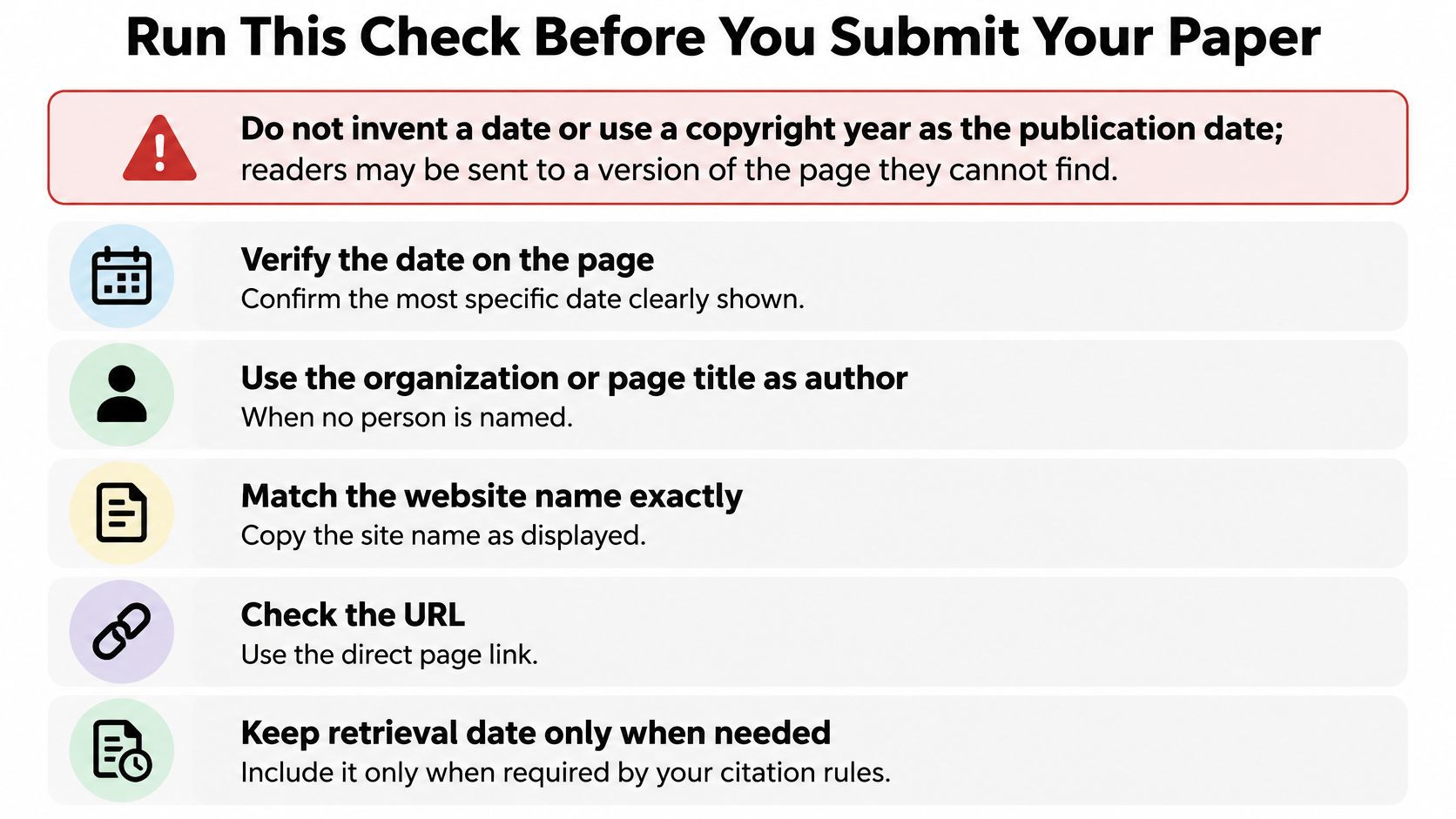
The costliest error is inventing a date or using a copyright year as the publication date. It sends your reader to a version of the page they can't find, and it undermines an otherwise correct entry. If you fix only one thing in a final pass, fix that.
The remaining errors are quick to spot once you name them:
- Default Anonymous. That label belongs only on works explicitly signed that way.
- Repeated site name. If the site is already the group author, it shouldn't appear twice.
- Whole-website citation. Evidence from one page needs that page's entry, not the site's.
- Retrieval date on a static article. A fixed page doesn't need one.
- Mismatched shortened title. Your in-text title must match the reference-list title and year.
Use the checklist visual as you run the numbered pass below it.
Your Five-Step Final Pass
- Confirm the author position against the table for each unsigned source.
- Confirm the reference order. Author, date, italic title, website name if different, URL.
- Confirm every in-text citation matches a reference-list title and year.
- Confirm n.d. appears in both places for undated pages, not just one.
- Confirm no retrieval date sits on a static page.
Keep a short note for each source as you research, recording the page date and the responsible organization next to the URL. That habit turns this check into minutes of verification instead of an hour of reopening tabs. For more habits like that, David T.C. Tutoring Services research tips collects practical pointers you can apply while you gather sources, not after you've drafted.
When your entries pass, do one last read of the full list for ordering and consistency. Our walkthrough on how to create a reference list helps you check hanging indents, alphabetizing, and spacing across mixed source types. A clean list signals the same care in your formatting that you've put into your argument.
If unsigned webpages are only one piece of a larger thesis, Thesis Book Project can help you plan chapters, organize sources, and track milestones from proposal to submission in one guided roadmap. Visit Thesis Book Project to structure your project and keep your references aligned with your drafts as you write.
Related Articles
How to Italicize in LaTeX: \Textit vs \Emph Explained
Use \textit{word} when you need italic type, and \emph{word} when you need emphasis. The comparison...
Academic SkillsAPA Chapter in an Edited Book: Templates and Examples
Chapter author, A. A. (Year). Chapter title in sentence case. In E. E. Editor (Ed.), Book title in i...
Academic SkillsHow to Create Reference List Without Citation Errors
You're close to submission, but your reference list still looks like a collection of database ex...
Comments (0)
No comments yet. Be the first to share your thoughts.