How to Write a Dissertation Abstract That Gets Read
Learn how to write a dissertation abstract that examiners and search engines actually read, with examples, common mistakes, and editing tips.
You've finished the dissertation, and now the last page is staring back at you. The abstract feels small compared with the rest of the project, but it carries a lot of weight, because it has to tell the whole story clearly, quickly, and in a form that both people and search systems can understand.
For most students, the hard part isn't knowing that an abstract should summarize the work. The hard part is deciding what to include, what to cut, and how to make it readable without making it vague. That balance is exactly what strong dissertation writing depends on.
Table of Contents
- What a Dissertation Abstract Is Really For
- The Four Building Blocks Every Abstract Needs
- Drafting Your Abstract in Four Blocks
- Writing for Humans and for Search
- Common Mistakes That Weaken Your Abstract
- A Final Editing Pass Before You Submit
- Putting It All Together
What a Dissertation Abstract Is Really For
At 11 p.m. on the night before submission, you reread the abstract and discover that it describes your topic, but not what the study found. The dissertation may be complete, yet this short page still shapes a reader's first judgment. Treat it as a working summary, not a final formality.
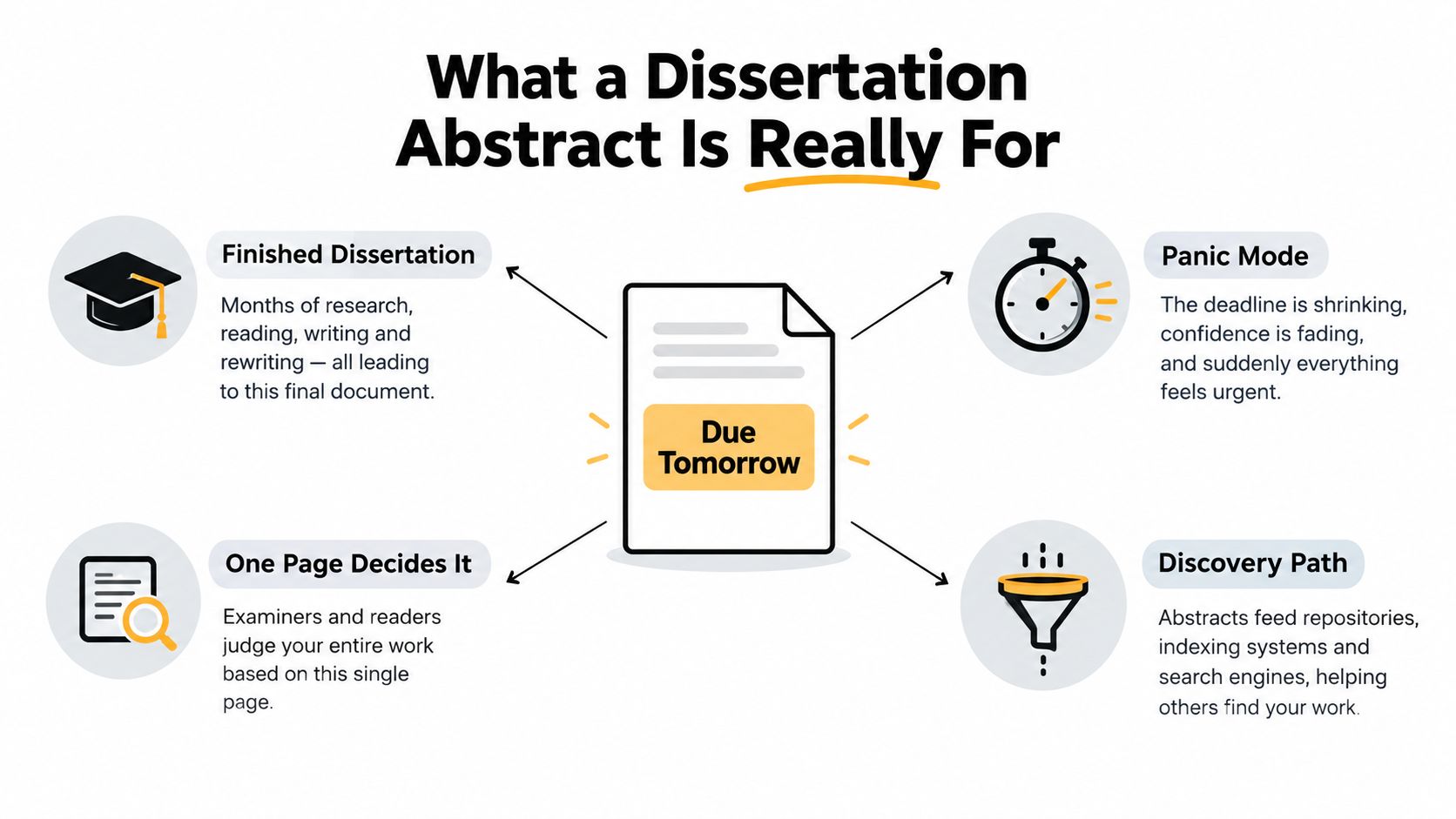
A dissertation abstract serves two readers at the same time. An examiner uses it as a map of the project, looking for the research problem, method, findings, and contribution before reading further. A researcher searching a repository encounters it as searchable text. Clear wording and relevant terms therefore need to work together. Keep the abstract in plain text, use the language researchers would search for, and organize the information so a human reader can follow it George Mason University.
The abstract is not the introduction
An introduction builds the route into the research. An abstract reports where the study arrived.
The introduction can establish background, review prior work, explain the gap, and prepare the reader for the research questions. The abstract has less room and a different responsibility. It must stand alone, giving enough information for someone who has not read the dissertation to understand the study's purpose, approach, results, and meaning.
That makes the abstract closer to a miniature report than a preface. It should present the problem, method, findings, and conclusion in a compact sequence, rather than promise what the dissertation will discuss.
Practical rule: If a stranger cannot tell what you studied, how you studied it, and what you found, revise the abstract before polishing individual sentences.
Searchability should support accuracy, not replace it. A keyword belongs in the abstract when it names the topic, population, method, or result clearly. Forced repetition makes the summary harder to read and can blur the study's actual contribution. In practice, draft for meaning first, then check whether the wording gives both readers a reliable route through the research.
The Four Building Blocks Every Abstract Needs
A reader may find your abstract in a database before ever seeing your dissertation. In a few moments, they should be able to identify the research problem, study design, main result, and contribution. That sequence also gives search systems clear language to index. University guidance commonly uses these four components as the basic shape of an effective abstract George Mason University.
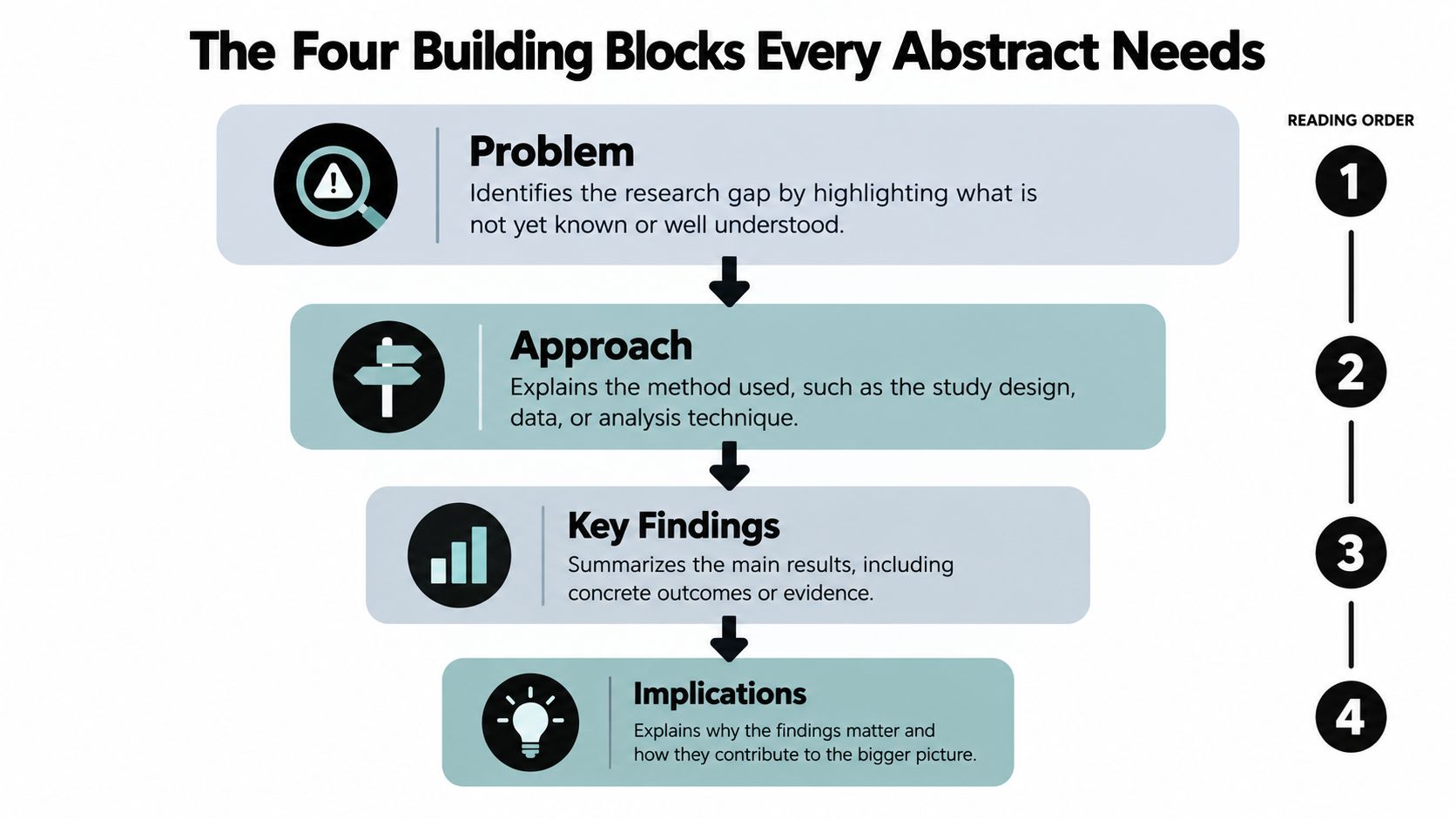
1. State the problem first
Open by naming the research issue or gap. Skip the long history lesson. One or two precise sentences can establish the topic, population, and reason the study deserves attention.
For a fictional qualitative study on remote-work burnout, a focused opening might be: “Remote-work burnout remains underexplored in teams that shifted permanently to hybrid scheduling, especially where informal boundaries between work and rest have disappeared.” It gives human readers a clear starting point and includes terms a search system can associate with the study.
2. Describe the method clearly
Readers need to know how you reached the result. Name the research approach, data source, sample, and analytical method when those details help establish the study's design. A method sentence could read: “The study used interviews with twelve employees across three departments and applied thematic analysis to identify recurring patterns in workload, availability, and recovery time.”
The method section is a map of the investigation, not a record of every procedure. For guidance on explaining research design in greater depth, see the methodology chapter guide.
3. Report the main findings
This block carries the evidence. Avoid replacing results with “the findings are discussed,” which tells the reader that an answer exists without giving the answer.
Weak: “The findings revealed several important themes relating to employee well-being.”
Stronger: “The analysis showed that constant messaging, blurred time boundaries, and pressure to appear responsive were closely linked to fatigue and reduced recovery.”
The stronger version identifies the observed pattern. Keep findings in the past tense and select the headline result rather than listing every minor observation. Specific wording also gives searchers a more accurate preview of the dissertation.
4. Finish with the contribution
End by answering, “So what?” Connect the result to theory, practice, or policy. A clear conclusion might say: “These findings suggest that managers need clearer communication norms if they want remote work to remain sustainable over time.” This sentence shows why the result matters without claiming more than the study supports.
Together, the four blocks form a compact account of the research. Most dissertations can fit them into roughly 150 to 300 words, depending on institutional rules Curtin University. If the draft feels bloated, look first for repeated context or conclusions. Keep the terms that identify the study, and remove wording that adds neither meaning nor discoverability.
Drafting Your Abstract in Four Blocks
Once the four blocks exist on the page, the work of editing is subtraction. A first draft often resembles a desk covered with research notes: everything matters to you, but the reader needs a clear path through the material. Keep the substance, then remove the wording that delays it.
Begin by reading each sentence aloud. Cut adjectives that add approval rather than information, such as “important,” “valuable,” or “contemporary” when the noun already makes the point. Combine sentences that describe the same idea. Replace broad phrases with the specific term a reader would use to find research on the topic. Precise language improves both readability and discoverability.
Use this test: if two sentences tell the reader the same thing in slightly different words, keep the sharper one.
Before and after compression
The example below shows how editing can remove background drift, weak qualifiers, and repeated conclusions without removing the study's substance.
| Weak Draft (220 words) | Tightened Draft (160 words) |
|---|---|
| This dissertation examines the issue of remote-work burnout in a contemporary workplace setting and explores a number of concerns that have become increasingly important in recent years. The study looks at how employees manage changing boundaries between home and work and how this affects their overall sense of well-being. A qualitative approach was used, and interviews were carried out with employees from several departments in one organisation. The data were analysed using thematic analysis in order to identify recurring patterns and themes that could provide insight into the issue. The findings suggest that employees often struggle to separate work time from personal time, and they report feeling under pressure to respond quickly and remain available for longer periods than expected. The dissertation also shows that managers may need to consider new policies and better support structures. These results may be useful for future research and may also have implications for workplace practice. | This dissertation investigates remote-work burnout in a hybrid organisation. It asks how employees experience boundary loss between home and work and what conditions intensify fatigue. The study used interviews with employees from three departments and analysed the data thematically. The findings show that constant messaging, unclear availability expectations, and the pressure to stay online were linked to lower recovery time and higher reported exhaustion. The dissertation concludes that clearer communication norms and more deliberate work-rest boundaries could make remote work more sustainable. |
The weak version spends too many words announcing the topic, repeats “may” and “suggest,” and postpones the study's point. The tightened version moves directly from the research problem to the study's approach, result, and implication. It also retains terms such as “remote-work burnout,” “hybrid organisation,” and “thematic analysis,” which help readers recognise the subject without making the prose sound like a list of search terms.
Before drafting, clarify the research problem in one sentence so the abstract has a firm centre. See how to shape a stronger problem statement before you draft
Three compression moves matter most. First, reduce the literature background to the single problem that the dissertation addresses. Second, combine scattered findings into one grammatical sequence, using parallel wording rather than separate fragments. Third, remove hedging such as “it may be argued that” unless your discipline requires that degree of caution. Keep qualifications that accurately limit the claim, but do not use them to avoid stating what the study found.
Make a compressed version, then read it as if you have never seen the dissertation. Could a new reader explain the topic, approach, main result, and contribution after one pass? If not, cut another layer of repetition or replace a general phrase with the study's precise language. The finished abstract should feel selective, not incomplete.
Writing for Humans and for Search
A dissertation abstract isn't only for the examiner at the desk. It also sits inside repository systems and search indexes, where the right wording helps the dissertation appear when someone looks for related work. University guidance stresses that abstracts should include key words and phrases, use plain language, and avoid unnecessary detail, because those features support both comprehension and discovery University of North Carolina Writing Center.
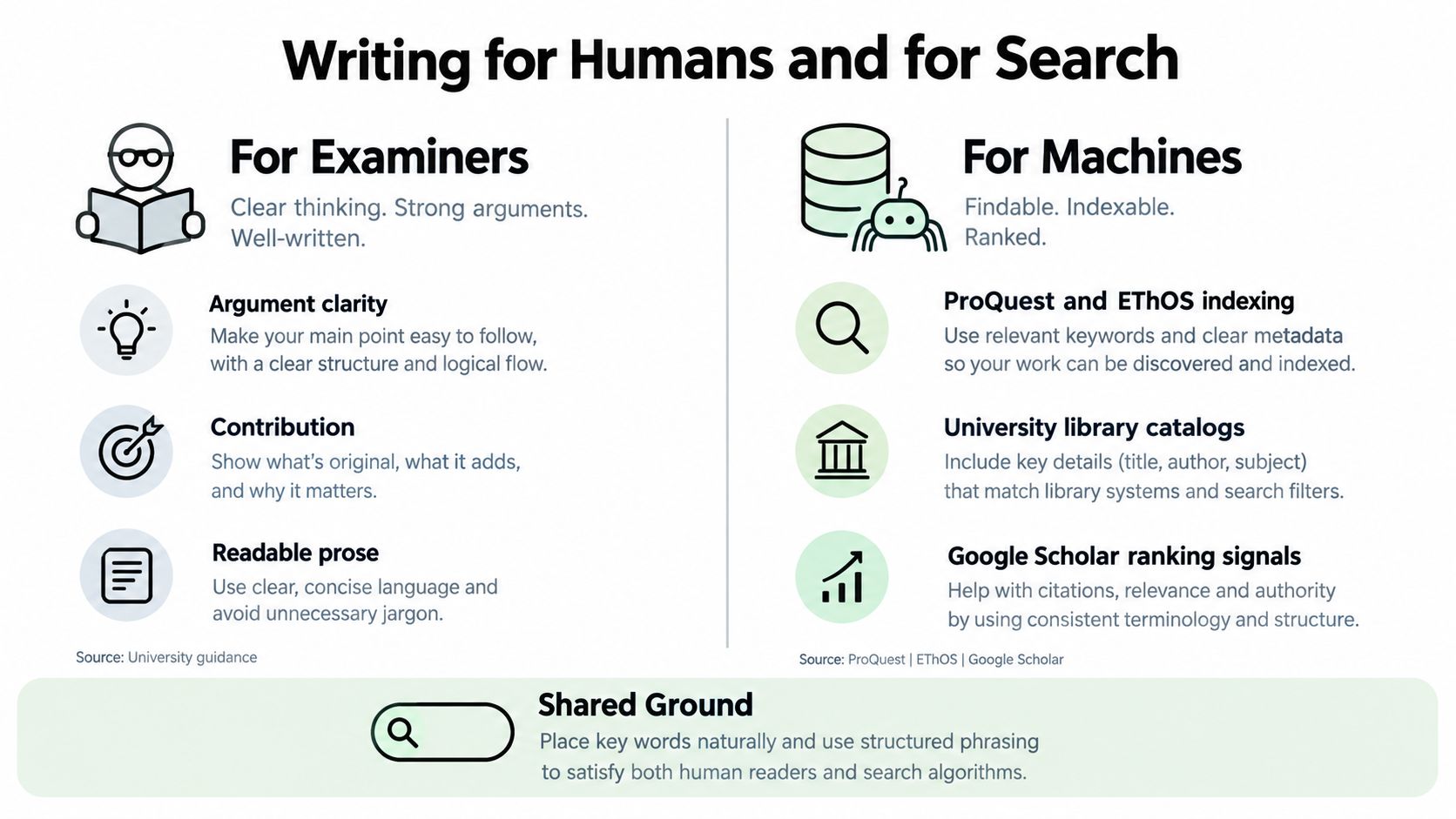
The practical tension is simple. Too little keyword use, and the abstract becomes hard to find. Too much keyword stuffing, and it reads like a search prompt instead of academic prose. The better approach is to place 4 to 6 core terms naturally in the abstract, especially around the problem statement, methodology, and population or setting.
Where keywords belong
Put the terms where they sound inevitable, not forced. If the dissertation is about remote-work burnout, hybrid teams, and thematic analysis, those phrases should appear in the opening and method sentences if they accurately describe the study. A reader should never feel that the writer has crammed in search terms after the fact.
Avoid synonyms that look obvious to you but might not be the exact phrases other researchers search for. If your field tends to use “social media marketing” rather than “digital promotion,” choose the phrase your audience uses. That's one reason a future-proof content strategy matters in academic writing too, because searchable language ages better when it matches real search behavior rather than private shorthand MyMentions.
Searchability works best when the wording still sounds like a person wrote it.
A quick test helps. Paste the abstract into Google Scholar and look at the nearby results. If the surrounding papers are clearly related, your language is probably doing the right job. If the search returns something odd, the abstract may be too narrow, too vague, or too full of jargon.
The primary goal is not to optimize for algorithms at the expense of clarity. It is to write a dual-audience summary that a tired examiner can follow at 11 p.m. and a researcher can still find three years later.
Common Mistakes That Weaken Your Abstract
A reader opens your abstract looking for a clear route through the study. If the research problem is hidden, the method is vague, or the result arrives too late, that route becomes difficult to follow. The same weaknesses also affect discoverability: a search system may index the words, but a researcher will not click a result that sounds generic or incomplete. The goal is a summary that works for both audiences.
The patterns that frustrate examiners
Starting with broad background instead of the research problem gives the reader no clear reason to continue. A weak version says, “Over the past decade, remote work has become increasingly common in many sectors.” A stronger version says, “This dissertation investigates how remote work contributes to burnout in hybrid teams.” The second sentence identifies the subject, relationship, and purpose. It also gives search systems meaningful terms to index.
Repeating the title in the opening line wastes space and can make the abstract sound mechanical. Instead of “This dissertation examines remote-work burnout in remote-work settings,” write “This dissertation examines how blurred availability norms shape burnout in hybrid teams.” The revised sentence adds a research problem rather than echoing the title.
Tense can create another source of confusion. Use past tense for completed methods and findings, then reserve present tense for general conclusions or implications. For example, “Interviews were conducted” describes the completed study, while “The findings suggest” introduces a claim that remains relevant. This distinction follows common university advice on abstract writing Curtin University.
A result should not be buried beneath several sentences of setup. If the reader has to search for the contribution, the abstract has lost its centre. Replace “The findings are discussed in relation to workplace policy” with “The analysis showed that unclear availability expectations were linked to longer recovery times.” The second version states what the study found, so the implication has something concrete to build on.
Weak version and strong version
| Weak Version | Strong Version | Why It Fails |
|---|---|---|
| This study examines an important issue in modern workplaces. | This dissertation examines how remote-work expectations contribute to burnout in hybrid teams. | It is vague and does not name the research problem. |
| Interviews were conducted and several themes emerged. | Interviews with twelve employees were analysed thematically, revealing three recurring sources of fatigue. | It hides the design and the result. |
| It may be argued that the findings have implications for practice. | The findings suggest that managers need clearer communication norms. | It weakens and delays the contribution. |
| References to previous authors are included here. | No citations appear in the abstract. | The abstract should stand alone. |
A useful companion resource is this guide to common submission issues that often slow thesis completion.
The most damaging mistakes often concern completeness and length. Overlength abstracts can be difficult to process and may exceed submission limits, while missing results leave readers unable to judge the study's contribution. Both problems can affect how an abstract is assessed before anyone considers the finer points of style PMC academic guidance. Once the summary states the problem, method, findings, and meaning in a controlled space, editing becomes much more manageable.
A Final Editing Pass Before You Submit
Read the finished abstract twice: first as a person deciding whether the dissertation is relevant, then as a search system sorting research by topic. The wording must work for both. Clear subject terms help indexing, but forced keywords make the prose harder to read.
Run this checklist
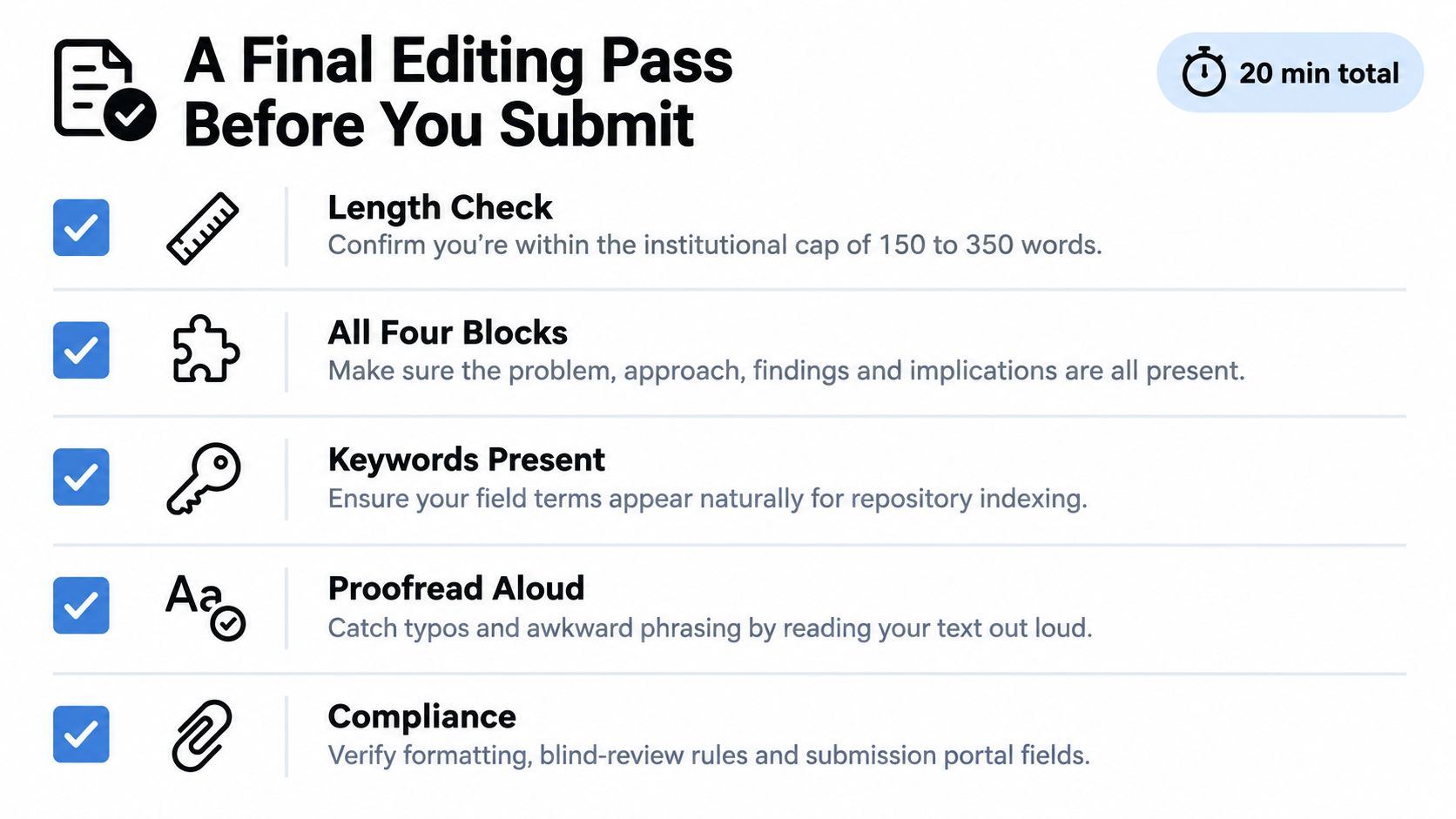
- Length check: Confirm that the abstract fits your institution's limit. A common range is 150 to 350 words, depending on university guidance Curtin University. If the draft runs long, remove repeated context before cutting a finding or implication.
- Four-block check: Verify that the problem, method, findings, and implications are all present. Each block should answer a different reader question rather than repeat the same claim.
- Search check: Keep the main topic and natural search terms in the opening sentences, but revise any phrase that sounds inserted for indexing. A reader should understand the subject without seeing the keyword strategy.
- Read-aloud check: Hearing the abstract exposes crowded sentences, repeated words, and abrupt changes that silent proofreading can miss.
- Compliance check: Remove citations, undefined acronyms, figures, and formatting that the submission system does not permit. The abstract should remain self-contained and readable University of North Carolina Writing Center.
Ask one final question: could someone who has not read the dissertation explain what you studied, how you studied it, what you found, and why it matters? If not, revise the unclear sentence before submitting.
Putting It All Together
The cleanest writing sequence is straightforward, even if the first draft isn't. Identify the audience, draft the four blocks in order, compress for clarity, layer in your natural keywords, then run the final checklist for length, tense, and formatting. That sequence keeps the abstract grounded in the finished dissertation instead of in early assumptions.
The abstract is written last for a reason. By the time the dissertation is complete, you finally know what the study really says, which findings deserve emphasis, and which lines only exist because they sounded good in an early draft Editage dissertation abstract guide. That's the moment to write a clean, self-contained summary that can stand on its own.
A polished dissertation abstract gives examiners a fast, accurate view of the work and gives search systems a clear text to index. Keep it concise, complete, and readable, and it will do exactly what it should.
Thesis Book Project helps students and researchers turn a dissertation into a manageable plan, from early structure to final submission. If you want a clearer workflow for drafting, revising, and tracking your thesis work, visit Thesis Book Project and see how its roadmap and chapter tools can support the process.
Related Articles
Literature Review vs Research Paper: Key Differences
You're halfway through a thesis when your supervisor writes, “Add a stronger literature review.”...
Research MethodsLiterature Review Organization Methods
Most advice about literature review organization starts in the wrong place. It tells students to pic...
Research MethodsWhat Is a Research Problem Statement: A Practical Guide
A research problem statement is a structured explanation of a specific gap or issue in existing know...
Comments (0)
No comments yet. Be the first to share your thoughts.